171 posters, 10 topics, 5 sessions, 690 authors, 211 institutions
ePostersLive by SciGen Technologies S.A. All rights reserved.
American Association of Plastic Surgeons Meeting 2022
April 9 - 12 | San Diego, California

P140
A Binary Logistic Regression Analysis Of Risk Factors For Failure Of Lower Extremity Salvage In Trauma Patients: An Examination Of The American College Of Surgeons Trauma Quality Improvement Project
Poster Presenter
Authors
Karen Burtt, Vincent Athas, Stacey Tannenbaum, James Fletcher, Alex Fokin, John Berne
Affiliations
Part of Topic
Hand/Extremity
A BINARY LOGISTIC REGRESSION ANALYSIS OF RISK FACTORS FOR FAILURE OF LOWER EXTREMITY SALVAGE IN TRAUMA PATIENTS: AN EXAMINATION OF THE AMERICAN COLLEGE OF SURGEONS TRAUMA QUALITY IMPROVEMENT PROJECT
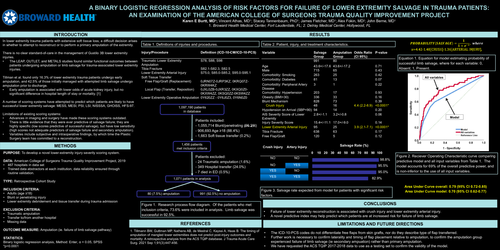
In lower extremity trauma patients with extensive soft tissue loss, a difficult decision arises in whether to attempt to reconstruct or to perform a primary amputation of the extremity. There is no clear standard-of-care in the management of Gustilo 3B lower extremity injuries. The LEAP, OUTLET, and METALS studies found similar functional outcomes between patients undergoing amputation or limb salvage for trauma-associated lower extremity injuries. Tillman et al. found only 16.3% of lower extremity trauma patients undergo early amputation, and 42.5% of those initially managed with attempted limb salvage undergo amputation prior to discharge. Early amputation is associated with lower odds of acute kidney injury, but no significant difference in hospital length of stay or mortality. [1] A number of scoring systems have attempted to predict which patients are likely to have successful lower extremity salvage: MESS, MESI, PSI, LSI, NISSSA, GHOISS, HFS-97. Limitations of existing scoring systems: Advances in imaging and surgery have made these scoring systems outdated. There is little evidence that they were ever predictive of salvage failure; they are highly specific (low scores predictive of successful salvage), but have low sensitivity (high scores not adequate predictors of salvage failure and secondary amputation). Variables include subjective and intraoperative findings, by which time the Plastic Surgery team has committed to a reconstruction.
PURPOSE: To develop a novel lower-extremity injury severity scoring system. DATA: American College of Surgeons Trauma Quality Improvement Project, 2019 467 hospitals in data set Trained data abstractors at each institution, data reliability ensured through routine validation. TYPE: Retrospective Cohort Study INCLUSION CRITERIA: Adults (age ≥18) Blunt or penetrating injury Lower extremity debridement and tissue transfer during trauma admission EXCLUSION CRITERIA: Traumatic amputation Transfer to/from another hospital Missing data OUTCOME MEASURE: Amputation (ie. failure of limb salvage pathway) STATISTICS: Binary logistic regression analysis, Method: Enter, α = 0.05, SPSS *p<0.0001
Failure of lower extremity reconstruction is associated with crush injury and lower extremity arterial injury. A novel predictive index may help predict which patients are at increased risk for failure of limb salvage.