171 posters, 10 topics, 5 sessions, 690 authors, 211 institutions
ePostersLive by SciGen Technologies S.A. All rights reserved.
American Association of Plastic Surgeons Meeting 2022
April 9 - 12 | San Diego, California

P138
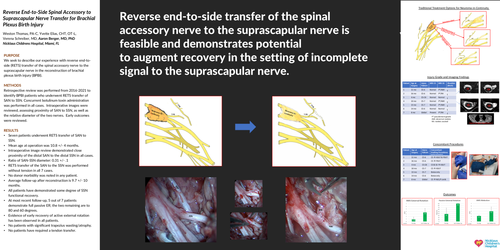
Reverse End-to-side Spinal Accessory To Suprascapular Supercharge Nerve Transfer For Brachial Plexus Birth Injury
Poster Presenter
Authors
Affiliations
Part of Topic
Hand/Extremity
PURPOSE
We seek to describe our experience with reverse end-to- side (RETS) transfer of the spinal accessory nerve to the
suprascapular nerve in the reconstruction of brachial plexus birth injury (BPBI).
METHODS
Retrospective review was performed from 2016-2021 to identify BPBI patients who underwent RETS transfer of SAN to SSN. Concurrent botulinum toxin administration was performed in all cases. Intraoperative images were reviewed, assessing proximity of SAN to SSN, as well as the relative diameter of the two nerves. Early outcomes were reviewed.
RESULTS
-
Seven patients underwent RETS transfer of SAN to SSN.
-
Mean age at operation was 10.8 +/- 4 months.
-
Intraoperative image review demonstrated close
proximity of the distal SAN to the distal SSN in all cases.
-
Ratio of SAN-SSN diameter: 0.31 +/- .1
-
RETS transfer of the SAN to the SSN was performed
without tension in all 7 cases.
-
No donor morbidity was noted in any patient.
-
Average follow-up after reconstruction is 9.7 +/- 10
months.
-
All patients have demonstrated some degree of SSN
functional recovery.
-
At most recent follow-up, 5 out of 7 patients
demonstrate full passive ER; the two remaining are to
80 and 60 degrees.
-
Evidence of early recovery of active external rotation
has been observed in all patients.
-
No patients with significant trapezius wasting/atrophy.
-
No patients have required a tendon transfer.
Reverse end-to-side transfer of the spinal accessory nerve to the suprascapular nerve is feasible and demonstrates potential to augment recovery of suprascapular nerve function in the setting of incomplete signal to the nerve (from nerve root avulsions and/or neuroma-in-continuity).