171 posters, 10 topics, 5 sessions, 690 authors, 211 institutions
ePostersLive by SciGen Technologies S.A. All rights reserved.
American Association of Plastic Surgeons Meeting 2022
April 9 - 12 | San Diego, California

P135
Superthin Profunda Artery Perforator Flap For Extremity Reconstruction: Radiological Analysis And Clinical Cases
Poster Presenter
Authors
Affiliations
Part of Topic
Hand/Extremity
BACKGROUND
For coverage of extremity wounds, traditional subfascial profunda artery perforator (PAP) flap harvest results in a flap which is too thick.
The aim of this study were as follows:
1)To characterize the suprafascialperforator anatomy of profunda artery perforators on preoperative CT angiography.
2)To describe our approach and experience with the superthinPAP flap for extremity reconstruction.
METHODS
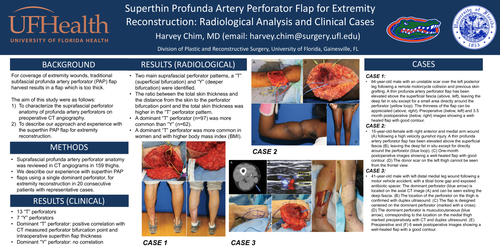
•Suprafascial profunda artery perforator anatomy was reviewed in CT angiograms in 159 thighs.
•We describe our experience with superthin PAP
•flaps using a single dominant perforator, for extremity reconstruction in 20 consecutive patients with representative cases.
RESULTS (CLINICAL)
•13 “T” perforators
•7 “Y” perforators
•Dominant “T” perforator: positive correlation with CT measured perforator bifurcation point and intraoperative superthin flap thickness
Dominant “Y” perforator: no correlation
RESULTS (RADIOLOGICAL)
•Two main suprafascial perforator patterns, a “T” (superficial bifurcation) and “Y” (deeper bifurcation) were identified.
•The ratio between the total skin thickness and the distance from the skin to the perforator bifurcation point and the total skin thickness was higher in the “T” perforator pattern.
•A dominant “T” perforator (n=97) was more common than “Y” (n=62).
•A dominant “T” perforator was more common in women and with higher body mass index (BMI).