171 posters, 10 topics, 5 sessions, 690 authors, 211 institutions
ePostersLive by SciGen Technologies S.A. All rights reserved.
American Association of Plastic Surgeons Meeting 2022
April 9 - 12 | San Diego, California

P133
Alterations Of Gait Mechanics Observed Using Wearable Gait Sensors In Patients With Diabetic Neuropathy
Poster Presenter
Authors
Zoë Haffner, Krishna Sharma, Firras Garada, John Miller, Christopher Attinger, John Steinberg, Jayson Atves, Karen Evans
Affiliations
MedStar Georgetown University Hospital, Department of Plastic and Reconstructive Surgery, Georgetown University School of Medicine, Foot and Ankle Specialists of the Mid-Atlantic
Part of Topic
Hand/Extremity
Alterations of Gait Mechanics Observed Using Wearable Gait Sensors In Patients with Diabetic Neuropathy
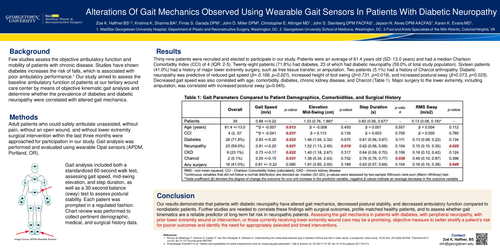
BACKGROUND: Few studies assess the objective ambulatory function and mobility of patients with chronic disease. Studies have shown diabetes increases the risk of falls, which is associated with poor ambulatory performance.1 Our study aimed to assess the baseline ambulatory function of patients at our tertiary wound care center by means of objective kinematic gait analysis and determine whether the prevalence of diabetes and diabetic neuropathy were correlated with altered gait mechanics.
METHODS: Adult patients who could safely ambulate unassisted, without pain, without an open wound, and without lower extremity surgical intervention within the last three months were approached for participation in our study. Gait analysis was performed and evaluated using wearable Opal sensors (APDM, Portland, OR).
Gait analysis included both a standardized 60-second walk test, assessing gait speed, mid-swing elevation, and step duration, as well as a 30-second balance (sway) test to assess postural stability. Each patient was prompted in a regulated fashion. Chart review was performed to collect pertinent demographic, medical, and surgical history data.
RESULTS: Thirty-nine patients were recruited and elected to participate in our study. Patients were an average of 61.4 years old (SD: 13.0 years) and had a median Charlson Comorbidity Index (CCI) of 4 (IQR: 2-5). Twenty-eight patients (71.8%) had diabetes, 23 of which had diabetic neuropathy (59.0% of total study population). Sixteen patients (41.0%) had a history of major lower extremity surgery, such as free tissue transfer, or amputation. Two patients (5.1%) had a history of Charcot arthropathy. Diabetic neuropathy was predictive of reduced gait speed (β=-0.166, p=0.021), increased height of foot swing (β=0.731, p=0.019), and increased postural sway (β=0.073, p=0.025). Decreased gait speed was also correlated with age, comorbidity, diabetes, chronic kidney disease, and Charcot (Table 1). Major surgery to the lower extremity, including amputation, was correlated with increased postural sway (p=0.045).
CONCLUSION: Our results demonstrate that patients with diabetic neuropathy have altered gait mechanics, decreased postural stability, and decreased ambulatory function compared to nondiabetic patients. Further studies are needed to correlate these findings with surgical outcomes, profile-matched healthy patients, and to assess whether gait kinematics are a reliable predictor of long-term fall risk in neuropathic patients. Assessing the gait mechanics in patients with diabetes, with peripheral neuropathy, with prior lower extremity wound or intervention, or those currently receiving lower extremity wound care may be a promising, objective measure to better stratify a patient’s risk for poorer outcomes and identify the need for appropriately selected and timed interventions.
REFERENCES:
1. Roman de Mettelinge T, Cambier D, Calders P, Van Den Noortgate N, Delbaere K. Understanding the relationship between type 2 diabetes mellitus and falls in older adults: a prospective cohort study. PLoS One. 2013;8(6):e67055. Published 2013 Jun 25. doi:10.1371/journal.pone.0067055
2. Washabaugh, Edward P et al. “Validity and repeatability of inertial measurement units for measuring gait parameters.” Gait & posture vol. 55 (2017): 87-93. doi:10.1016/j.gaitpost.2017.04.013