171 posters, 10 topics, 5 sessions, 690 authors, 211 institutions
ePostersLive by SciGen Technologies S.A. All rights reserved.
American Association of Plastic Surgeons Meeting 2022
April 9 - 12 | San Diego, California

P132
Minimally Invasive Tenolysis With Fat Grafting: A Novel Approach
Poster Presenter
Authors
Affiliations
Part of Topic
Hand/Extremity
Minimally Invasive Tenolysis With Fat Grafting: A Novel Approach
Raul Cortes, MD, FACS - Daniel Calva-Cerqueira, MD, FACS - Roger K Khouri, MD, FACS
Miami Hand Center
Miami, Florida
Introduction
Stiffness with loss of motion represents the Achilles heel of hand surgery and hinders optimal surgical outcomes. Pathology such as tendon lacerations, fracture, dislocations, and crush injuries may be accurately managed in the operating room but ultimately fail to return to preinjury status despite dedicated postoperative hand therapy. Dermal fat grafting provides a gliding tendon surface that reduces scar formation and optimized wound conditions. Tenolysis is one modality that addresses stiffness by mechanically disrupting scar tissue formed around tendons. We describe our experience with a novel technique using minimally invasive approaches and using dermal fat grafting. Dermal fat grafting provides a gliding tendon surface, reduces scar formation, and optimized wound conditions.
Methods and Materials
All patients from a single hand surgery practice comprising of three surgeons who underwent a tenolysis over 4 years from 2017 to 2021 were included. Only procedures noted as secondary procedures were included.
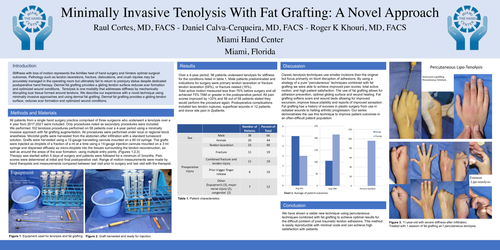
We performed 102 tenolysis procedures performed on 58 patients over a 4-year period using a minimally invasive approach with fat grafting augmentation. All procedures were performed under local or regional block anesthesia. Microfat grafts were harvested from the abdomen after infiltration with a standard tumescent solution. Grafts were harvested using a 12-gauge harvesting cannula mounted on a 60 ml syringe. The grafts were injected as droplets of a fraction of an ml at a time using a 14-gauge injection cannula mounted on a 3 ml syringe and dispersed diffusely as micro-droplets into the tissues surrounding the tendon reconstruction, as well as around the areas of the scar formation, using multiple entry points. (Figures 1,2,3)
Therapy was started within 5 days of surgery and patients were followed for a minimum of 3months. Pain scores were determined at the initial and final postoperative visit. Range of motion measurements were made by hand therapists and measurements compared between the last visit prior to surgery and the last visit with the therapist.
Results
Over a 4-year period, 58 patients underwent tenolysis for stiffness for the conditions listed in table 1. Male patients predominated and indications for surgery were primary tendon laceration or fracture tendon laceration (59%), or fracture-related (19%).
Total active motion measured less than 75% before surgery and all achieved 75% TAM or greater in the postoperative period. All pain scores improved by >33% and 56 out of 58 patients stated they would perform the procedure again. Postoperative complications included two tendon ruptures, superficial wounds in 12 patients, and donor site pain in 2 patients.
Discussion
Classic tenolysis techniques use smaller incisions than the original but focus primarily on blunt disruption of adhesions. By using a strategy of a pure “percutaneous” techniques combined with fat grafting we were able to achieve improved pain scores, total active motion, and high patient satisfaction. The use of fat grafting allows for adhesion prevention, optimal gliding surface and wound healing. Fat grafting softens scars and wound beds allowing for improved excursion, improve tissue pliability and reports of improved sensation. Fat grafting has a history of success in plastic surgery from use in radiated wounds to halting arthritic progression. Our series demonstrates the use this technique to improve patient outcomes in an often-difficult patient population.
Conclusion
We have shown a viable new technique using percutaneous techniques combined with fat grafting to achieve optimal results for the difficult problem of post traumatic tendon adhesions. This method is easily reproducible with minimal costs and can achieve high satisfaction with patients.