171 posters, 10 topics, 5 sessions, 690 authors, 211 institutions
ePostersLive by SciGen Technologies S.A. All rights reserved.
American Association of Plastic Surgeons Meeting 2022
April 9 - 12 | San Diego, California

P83
Late Presentation Of Non-syndromic Craniosynostosis: Does Socioeconomic Status Matter?
Poster Presenter
Part of Topic
Craniofacial/Peds
Late Presentation of Non-Syndromic Craniosynostosis: Does Socioeconomic Status Matter?
Isabel V Lake, BS*1; Christopher D Lopez, MD*1; Alisa O Girard, MBS1; Kimberly H Khoo, MPH1; Ainsley Taylor, BS1; Joseph Lopez, MD, MBA1; Richard J Redett, MD1; Robin Yang, MD, DDS1
1Department of Plastic and Reconstructive Surgery, Johns Hopkins University School of Medicine, Baltimore, MD, USA; *Authors contributed equally
INTRODUCTION
Patients with non-syndromic craniosynostosis (NSC) generally undergo surgical management prior to 12 months of age to attenuate the surgical risks and complexities of delayed care.
Though many patients still receive primary surgery after 1 year, this cohort is poorly understood.
This study aims to identify demographic and clinical contributors to gaps in care for NSC patients who experience surgical delays.
OBJECTIVES
MATERIALS AND METHODS
Patients: A total of 699 NSC patients were identified as having primary corrective surgery at a Johns Hopkins Hospital from 1992-2022.
Variables of Interest: Demographic and clinical data, as well as care timeline and outcomes were collected via chart review.
Analysis: Linear regression was conducted for all variables with time to surgery and time from diagnosis to surgery as outcome variables.
CONCLUSIONS
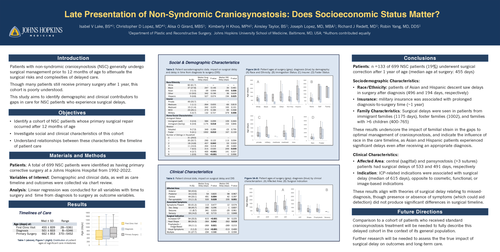
Patients: n =133 of 699 NSC patients (19%) underwent surgical correction after 1 year of age (median age at surgery: 455 days)
Sociodemographic Characteristics:
These results underscore the impact of familial strain in the gaps to optimal management of craniosynostosis, and indicate the influence of race in the care timeline, as Asian and Hispanic patients experienced significant delays even after receiving an appropriate diagnosis.
Clinical Characteristics:
These results align with theories of surgical delay relating to missed-diagnosis, though presence or absence of symptoms (which could aid detection) did not produce significant differences in surgical timeline.
FUTURE DIRECTIONS
Comparison to a cohort of patients who received standard craniosynostosis treatment will be needed to fully describe this delayed cohort in the context of its general population.
Further research will be needed to assess the the true impact of surgical delay on outcomes and long-term care.