171 posters, 10 topics, 5 sessions, 690 authors, 211 institutions
ePostersLive by SciGen Technologies S.A. All rights reserved.
American Association of Plastic Surgeons Meeting 2022
April 9 - 12 | San Diego, California

P81
Treatment Of Persistent Post-traumatic Diplopia - An Algorithmic Approach To Patient Stratification And Operative Management
Poster Presenter
Authors
Affiliations
Part of Topic
Craniofacial/Peds
Treatment of Persistent Post-traumatic Diplopia - an Algorithmic Approach to Patient Stratification and Operative Management
INTRODUCTION:
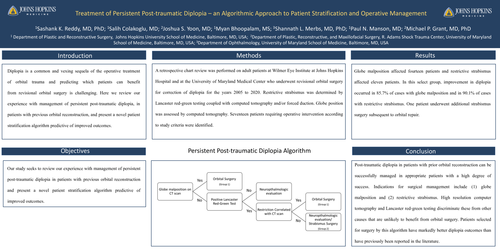
Diplopia is a common and vexing sequela of the operative treatment of orbital trauma and predicting which patients can benefit from revisional orbital surgery is challenging. Here we review our experience with management of persistent post-traumatic diplopia, in patients with previous orbital reconstruction, and present a novel patient stratification algorithm predictive of improved outcomes.
OBJECTIVES:
Our study seeks to review our experience with management of persistent post-traumatic diplopia in patients with previous orbital reconstruction and present a novel patient stratification algorithm predictive of improved outcomes.
METHODS:
A retrospective chart review was performed on adult patients at Wilmer Eye Institute at Johns Hopkins Hospital and at the University of Maryland Medical Center who underwent revisional orbital surgery for correction of diplopia for the years 2005 to 2020. Restrictive strabismus was determined by Lancaster red-green testing coupled with computed tomography and/or forced duction. Globe position was assessed by computed tomography. Seventeen patients requiring operative intervention according to study criteria were identified.
RESULTS:
Globe malposition affected fourteen patients and restrictive strabismus affected eleven patients. In this select group, improvement in diplopia occurred in 85.7% of cases with globe malposition and in 90.1% of cases with restrictive strabismus. One patient underwent additional strabismus surgery subsequent to orbital repair.
CONCLUSIONS
Post-traumatic diplopia in patients with prior orbital reconstruction can be successfully managed in appropriate patients with a high degree of success. Indications for surgical management include (1) globe malposition and (2) restrictive strabismus. High resolution computer tomography and Lancaster red-green testing discriminate these from other causes that are unlikely to benefit from orbital surgery. Patients selected for surgery by this algorithm have markedly better diplopia outcomes than have previously been reported in the literature.