171 posters, 10 topics, 5 sessions, 690 authors, 211 institutions
ePostersLive by SciGen Technologies S.A. All rights reserved.
American Association of Plastic Surgeons Meeting 2022
April 9 - 12 | San Diego, California

P79
Refining Operative Indications For Zygomaticomaxillary Complex Fracture Repair
Poster Presenter
Part of Topic
Craniofacial/Peds
Refining Operative Indications for Zygomaticomaxillary Complex Fracture Repair
Introduction
-
The zygomaticomaxillary complex (ZMC) is the keystone of the midface.
-
Although ZMC fractures are among the most common facial injuries, the optimal indications for repair remain controversial.
-
Clinical symptomatology of ZMC fractures commonly include: malar flattening, facial asymmetry, appreciable displacement, palpable step-off, malocclusion (misaligned teeth), trismus (limited range of motion in the jaw), paresthesias, diplopia, and enophthalmos.
-
The primary aim of this study is to identify specific pre-operative radiographic findings that relate to injury-specific symptomatology in patients with ZMC fractures.
-
Retrospective analysis of patients with ZMC fractures seen at a Level I Trauma Center between 2015 and 2020.
-
Exclusion criteria: patients with additional midfacial fractures beyond the zygoma.
-
Variables recorded from the medical record: patient demographics, CT characteristics (degree of anatomic displacement), and symptoms indicating surgical intervention.
-
Logistic regression analyses elucidated relationships between impaction measurements on CT imaging and symptomatology necessitating surgery.
-
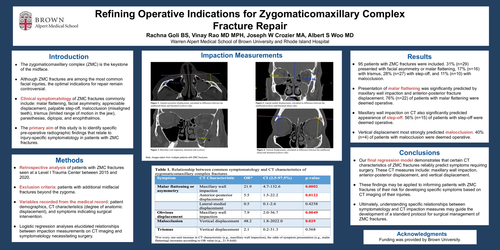
95 patients with ZMC fractures were included. 31% (n=29) presented with facial asymmetry or malar flattening, 17% (n=16) with trismus, 28% (n=27) with step-off, and 11% (n=10) with malocclusion.
-
Presentation of malar flattening was significantly predicted by maxillary wall impaction and anterior-posterior fracture displacement. 76% (n=22) of patients with malar flattening were deemed operative.
-
Maxillary wall impaction on CT also significantly predicted appearance of step-off. 56% (n=15) of patients with step-off were deemed operative.
-
Vertical displacement most strongly predicted malocclusion. 40% (n=4) of patients with malocclusion were deemed operative.
-
Our final regression model demonstrates that certain CT characteristics of ZMC fractures reliably predict symptoms requiring surgery. These CT measures include: maxillary wall impaction, anterior-posterior displacement, and vertical displacement.
-
These findings may be applied to informing patients with ZMC fractures of their risk for developing specific symptoms based on CT imaging of their injuries.
-
Ultimately, understanding specific relationships between symptomatology and CT impaction measures may guide the development of a standard protocol for surgical management of ZMC fractures.