171 posters, 10 topics, 5 sessions, 690 authors, 211 institutions
ePostersLive by SciGen Technologies S.A. All rights reserved.
American Association of Plastic Surgeons Meeting 2022
April 9 - 12 | San Diego, California

P77
Large Defect Forehead Reconstruction: Aesthetic Unit Principles For Reconstruction
Poster Presenter
Authors
Ainsley Taylor, Alexander Sun, Navin Singh, Maurice Nahabedian, Anthony Tufaro, Paul Manson, Sashank Reddy
Affiliations
Part of Topic
Craniofacial/Peds
Large Defect Forehead Reconstruction: Aesthetic Unit Principles for Reconstruction
Ainsley L. Taylor, BS, Alexander H. Sun, MD, Navin Singh, MD, Maurice Nahabedian, MD, Anthony Tufaro, MD, DDS, Paul N. Manson, MD, Sashank K. Reddy, MD, PhD
Department of Plastic and Reconstructive Surgery, Johns Hopkins University School of Medicine, Baltimore, MD, USA;
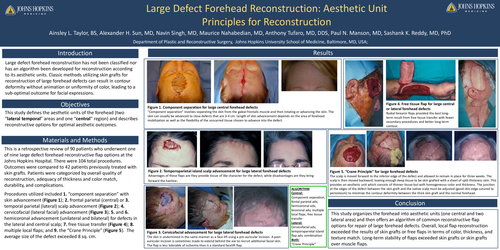
Large defect forehead reconstruction has not been classified nor has an algorithm been developed for reconstruction according to its aesthetic units. Classic methods utilizing skin grafts for reconstruction of large forehead defects can result in contour deformity without animation or uniformity of color, leading to a sub-optimal outcome for facial expressions.
This study defines the aesthetic units of the forehead (two “lateral temporal” areas and one “central” region) and describes reconstructive options for optimal aesthetic outcomes.
This is a retrospective review of 90 patients who underwent one of nine large defect forehead reconstructive flap options at the Johns Hopkins Hospital. There were 104 total procedures. Outcomes were compared to 42 patients previously treated with skin grafts. Patients were categorized by overall quality of reconstruction, adequacy of thickness and color match, durability, and complications.
Procedures utilized included 1. “component separation” with skin advancement (Figure 1); 2. frontal parietal (central) or 3. temporal parietal (lateral) scalp advancement (Figure 2); 4. cervicofacial (lateral facial) advancement (Figure 3); 5. and 6. hemicoronal advancement (unilateral and bilateral) for defects in the lateral and central scalp; 7. free tissue transfer (Figure 4); 8. multiple local flaps; and 9. the “Crane Principle” (Figure 5). The average size of the defect exceeded 8 sq. cm.
Figure 1. Component separation for large central forehead defects
“Component separation” involves separating the skin from the galeal frontalis muscle and then rotating or advancing the skin. The skin can usually be advanced to close defects that are 3-4 cm. Length of skin advancement depends on the area of forehead mobilization as well as the flexibility of the unscarred tissue chosen to advance into the defect.
Figure 2. Temporoparietal island scalp advancement for large lateral forehead defects
Advantages of these flaps are they provide tissue of like character for the defect, while disadvantages are they bring forward the hairline.
Figure 3. Cervicofacial advancement for large lateral forehead defects
The skin is undermined in the same manner as a face lift using a pre-auricular incision. A post-auricular incision is sometimes made to extend behind the ear to recruit additional facial skin. The flap is less tolerable of ischemia than is a standard facelift flap.
Figure 4. Free tissue flap for large central or lateral forehead defects
Radial forearm flaps provided the best long-term result from free tissue transfer with fewer secondary procedures and better long-term contour.
Figure 5. “Crane Principle” for large forehead defects
The scalp is moved forward to the inferior edge of the defect and allowed to remain in place for three weeks. The scalp is then moved backward, leaving enough deep tissue to be skin grafted with a sheet of split thickness skin. This provides an aesthetic unit which consists of thinner tissue but with homogeneous color and thickness. The junction at the edges of the defect between the skin graft and the native scalp must be adjusted (good skin edge sutured to periosteum) to minimize the contour deformity between the thick skin graft and the normal forehead.
ALGORITHM
Central:
Component separation, fontal parietal adv, hemicoronal adv, bicoronal adv, multiple local flaps, free tissue transfer
Lateral:
Cervicofacial adv, temporoparietal island flap adv, combination
Both:
“Crane Principle”
This study organizes the forehead into aesthetic units (one central and two lateral area) and then offers an algorithm of common reconstructive flap options for repair of large forehead defects. Overall, local flap reconstruction exceeded the results of skin grafts or free flaps in terms of color, thickness, and texture match. Long-term stability of flaps exceeded skin grafts or skin grafts over muscle flaps.