171 posters, 10 topics, 5 sessions, 690 authors, 211 institutions
ePostersLive by SciGen Technologies S.A. All rights reserved.
American Association of Plastic Surgeons Meeting 2022
April 9 - 12 | San Diego, California

P76
Single Z-plasty Versus Double-opposing Z-plasty: A Comparison Of Success With Palatal Lengthening
Poster Presenter
Part of Topic
Craniofacial/Peds
Single Z-plasty Versus Double-opposing Z-plasty: A Comparison of Success with Palatal Lengthening
Neel Vishwanath, BS1; Julia Lerner, MA1; Vinay Rao, MD, MPH1; Joseph Crozier, MA1; Albert Woo, MD1
Division of Plastic and Reconstructive Surgery, The Warren Alpert Medical School of Brown University, Providence, Rhode Island.
Background
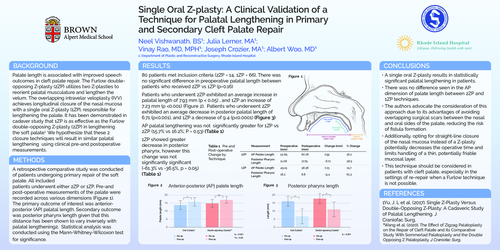
Palate length is associated with improved speech outcomes in cleft palate repair. The Furlow double-opposing Z-plasty (2ZP) utilizes two Z-plasties to reorient palatal musculature and lengthen the velum. The overlapping intravelarveloplasty (IVV) achieves longitudinal closure of the nasal mucosa with a single oral Z-plasty (1ZP), responsible for lengthening the palate. It has been demonstrated in cadaver study that 1ZP is as effective as the Furlow double-opposing Z-plasty (2ZP) in lengthening the soft palate1. We hypothesize that these 2 closure techniques will result in similar palatal lengthening using clinical pre-and postoperative measurements.
Methods
A retrospective comparative study was conducted of patients undergoing primary repair of the soft palate. All included patients underwent either 2ZP or 1ZP. Pre-and post-operative measurements of the palate were recorded across various dimensions (Figure 1). The primary outcome of interest was anterior-posterior (AP) palatal length. Secondary outcome was posterior pharynx length given that this distance has been shown to vary inversely with palatal lengthening2. Statistical analysis was conducted using the Mann-Whitney-Wilcoxon test for significance.
Results