4,068 posters, 219 videos, 101 topics, 69 sessions, 14,365 authors, 6,128 institutions
ePostersLive by SciGen Technologies S.A. All rights reserved.
Alzheimer's Association International Conference 2026
July 12-15, 2026 | London, United Kingdom, and Online

13866
Clinical Burden Of Advanced Autosomal Dominant Alzheimer's Disease In Home-based Care
Poster Presenter
Part of Topic
Dementia Care and Psychosocial Factors -> Dementia Care and Health Services Research -> End-of-life care (e.g., hospice care)
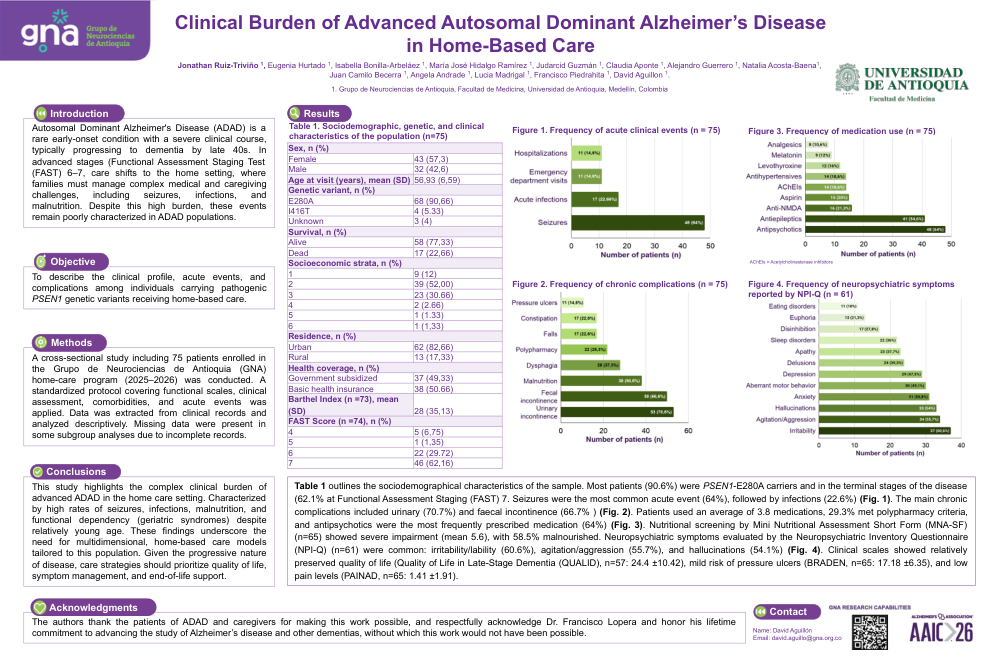
Clinical Burden of Advanced Autosomal Dominant Alzheimer’s Disease in Home-Based Care
Authors: Jonathan Ruiz-Triviño 1, Eugenia Hurtado 1, Isabella Bonilla-Arbeláez 1, María José Hidalgo Ramírez 1, Judarcid Guzmán 1, Claudia Aponte 1, Alejandro Guerrero 1, Natalia Acosta-Baena1, Juan Camilo Becerra 1, Angela Andrade 1, Lucia Madrigal 1, Francisco Piedrahita 1, David Aguillon 1.
1. Grupo de Neurociencias de Antioquia, Facultad de Medicina, Universidad de Antioquia, Medellín, Colombia
Introduction
Autosomal Dominant Alzheimer's Disease (ADAD) is a rare early-onset condition with a severe clinical course, typically progressing to dementia by late 40s. In advanced stages (Functional Assessment Staging Test (FAST) 6–7, care shifts to the home setting, where families must manage complex medical and caregiving challenges, including seizures, infections, and malnutrition. Despite this high burden, these events remain poorly characterized in ADAD populations.
Methods
A cross-sectional study including 75 patients enrolled in the Grupo de Neurociencias de Antioquia (GNA) home-care program (2025–2026) was conducted. A standardized protocol covering functional scales, clinical assessment, comorbidities, and acute events was applied. Data was extracted from clinical records and analyzed descriptively. Missing data were present in some subgroup analyses due to incomplete records.
Results
Table 1 outlines the sociodemographical characteristics of the sample. Most patients (90.6%) were PSEN1-E280A carriers and in the terminal stages of the disease (62.1% at Functional Assessment Staging (FAST) 7. Seizures were the most common acute event (64%), followed by infections (22.6%) (Fig. 1). The main chronic complications included urinary (70.7%) and faecal incontinence (66.7% ) (Fig. 2). Patients used an average of 3.8 medications, 29.3% met polypharmacy criteria, and antipsychotics were the most frequently prescribed medication (64%) (Fig. 3). Nutritional screening by Mini Nutritional Assessment Short Form (MNA-SF) (n=65) showed severe impairment (mean 5.6), with 58.5% malnourished. Neuropsychiatric symptoms evaluated by the Neuropsychiatric Inventory Questionnaire (NPI-Q) (n=61) were common: irritability/lability (60.6%), agitation/aggression (55.7%), and hallucinations (54.1%) (Fig. 4). Clinical scales showed relatively preserved quality of life (Quality of Life in Late-Stage Dementia (QUALID), n=57: 24.4 ±10.42), mild risk of pressure ulcers (BRADEN, n=65: 17.18 ±6.35), and low pain levels (PAINAD, n=65: 1.41 ±1.91).
Conclusions
This study highlights the complex clinical burden of advanced ADAD in the home care setting. Characterized by high rates of seizures, infections, malnutrition, and functional dependency (geriatric syndromes) despite relatively young age. These findings underscore the need for multidimensional, home-based care models tailored to this population. Given the progressive nature of disease, care strategies should prioritize quality of life, symptom management, and end-of-life support.
Acknowledgments
The authors thank the patients of ADAD and caregivers for making this work possible, and respectfully acknowledge Dr. Francisco Lopera and honor his lifetime commitment to advancing the study of Alzheimer’s disease and other dementias, without which this work would not have been possible.
Comments
Email is required but is not shown publicly.
Loading comments...