4,068 posters, 219 videos, 101 topics, 69 sessions, 14,365 authors, 6,128 institutions
ePostersLive by SciGen Technologies S.A. All rights reserved.
Alzheimer's Association International Conference 2026
July 12-15, 2026 | London, United Kingdom, and Online

13799
Quantifying The Pan-africanAlzheimer’s DiseaseCrisis: System Deficits & Task-shifted Diagnostics
Poster Presenter
Authors
Part of Topic
Dementia Care and Psychosocial Factors -> Dementia Care and Health Services Research -> Health and healthcare disparities
Ishaq Oyeshina Sanusi1, Tejiri Great Napoleon, Bachelor of Medicine and Bachelor of Surgery2, Deborah Akinride1, Emmanuela Ojoagefu Egwu3, Ogheneakpobor Ogbodu4, Emmanuel Kodizuru Chukwuemeka1, Ojo Israel Ifeoluwa1, Elete Shola Tabitha5, Eleyinmi Oluwafunmilayo Dorcas6, Ogunmekan Precious Anuoluwapo7, Ucheobi Nonso Christopher8, Olaniran Oluwatosin Emmanuel1, Ogban Nsenanzama Eko9, Chioma Nnedinma Duru10, Ehiwogwu Victoria Ifeoma11.
1College of Medicine, University Of Ibadan, Ibadan, Nigeria, 2Federal Medical Centre, Abeoukuta, Ogun State, Abeoukuta, Nigeria, 3Department of Medicine and Surgery, Bowen University Iwo, Osun, Nigeria, Iwo, Nigeria, 4Delta State University Teaching Hospital, Oghara, Oghara, Nigeria, 5Grodno State Medical University, Belarus., Grodno, Belarus, 6Sofia University 'St. Kliment Ohridski faculty of Medicine, Sofia, Bulgaria., Sofia, Bulgaria, 7Afe Babalola University, Ekiti state, Ekiti, Nigeria, 8Chukwuemeka Odumegwu Ojukwu University Teaching Hospital, Awka, Anamebra state., Awka, Nigeria, 9University of Calabar Teaching Hospital., Calabar, Nigeria, 10Gregory University Uturu, Abia State, Abia, Nigeria, 11Delta state University Teaching Hospital, Oghara, Oghara, Nigeria.
Abstract:
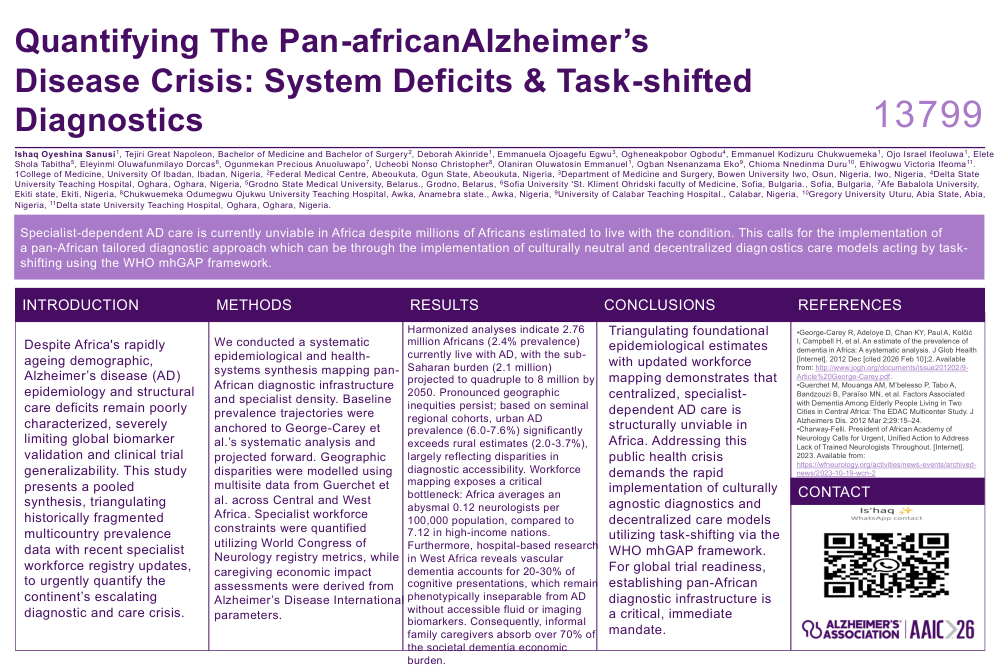
Background: Despite Africa's rapidly ageing demographic, Alzheimer’s disease (AD) epidemiology and structural care deficits remain poorly characterized, severely limiting global biomarker validation and clinical trial generalizability This study presents a pooled synthesis, triangulating historically fragmented multicountry prevalence data with recent specialist workforce registry updates, to urgently quantify the continent’s escalating diagnostic and care crisis.
Methods: We conducted a systematic epidemiological and health-systems synthesis mapping pan-African diagnostic infrastructure and specialist density. Baseline prevalence trajectories were anchored to George-Carey et al.’s systematic analysis and projected forward. Geographic disparities were modelled using multisite data from Guerchet et al. across Central and West Africa. Specialist workforce constraints were quantified utilizing World Congress of Neurology registry metrics, while caregiving economic impact assessments were derived from Alzheimer’s Disease International parameters.
Results: Harmonized analyses indicate 2.76 million Africans (2.4% prevalence) currently live with AD, with the sub-Saharan burden (2.1 million) projected to quadruple to 8 million by 2050. Pronounced geographic inequities persist; based on seminal regional cohorts, urban AD prevalence (6.0-7.6%) significantly exceeds rural estimates (2.0-3.7%), largely reflecting disparities in diagnostic accessibility. Workforce mapping exposes a critical bottleneck: Africa averages an abysmal 0.12 neurologists per 100,000 population, compared to 7.12 in high-income nations. Furthermore, hospital-based research in West Africa reveals vascular dementia accounts for 20-30% of cognitive presentations, which remain phenotypically inseparable from AD without accessible fluid or imaging biomarkers. Consequently, informal family caregivers absorb over 70% of the societal dementia economic burden.
Conclusion: Triangulating foundational epidemiological estimates with updated workforce mapping demonstrates that centralized, specialist-dependent AD care is structurally unviable in Africa. Addressing this public health crisis demands the rapid implementation of culturally agnostic diagnostics and decentralized care models utilizing task-shifting via the WHO mhGAP framework. For global trial readiness, establishing pan-African diagnostic infrastructure is a critical, immediate mandate.
Comments
Email is required but is not shown publicly.
Loading comments...