4,068 posters, 219 videos, 101 topics, 69 sessions, 14,365 authors, 6,128 institutions
ePostersLive by SciGen Technologies S.A. All rights reserved.
Alzheimer's Association International Conference 2026
July 12-15, 2026 | London, United Kingdom, and Online

13520
Empowering Community Members To Promote Dementia Research Participation In High-risk Communities: Results From A Realist Review
Poster Presenter
Authors
Sarah Walter, Sarah Gregory, Ríona Mc Ardle, Yajing Wang, Mouna Sawan, Josefine Antoniades, Allison Gibson, Joseph M Costello, Cynthia Huling Hummel, Paul Aisen, Rebecca Hunter, Colin Chandler, Leah Macaden
Affiliations
School of Health in Social Science, the University of Edinburgh; Epstein Family Alzheimer’s Therapeutic Research Institute, University of Southern California, School of Medicine, University of St Andrews; Scottish Brain Sciences Translational and Clinical Research Institute;, Newcastle University, Newcastle Upon Tyne, UK, Newcastle’s National Institute for Health and Care Research (NIHR) Biomedical Research Centre, School of Health in Social Science, the University of Edinburgh, School of Pharmacy, Faculty of Medicine and Health, The University of Sydney, La Trobe University, Saint Louis University, Alzheimer’s Clinical Trials Consortium, Research Ambassador Community Collective, Faculty of Health and Life Sciences, Northumbria University, Nursing Studies, School of Health in Social Science, the University of Edinburgh
Part of Topic
Dementia Care and Psychosocial Factors -> Dementia Care and Health Services Research -> Person-centered,-partnered, or led research
Video
Empowering community members to promote dementia research participation in high-risk communities: results from a realist review
Sarah Walter1,2, Sarah Gregory1,3,4, Ríona Mc Ardle5,6, Yajing Wang1, Mouna Sawan7, Josefine Antoniades8, Allison Gibson9, Joseph M Costello10, Cynthia Huling Hummel10, Paul Aisen2, Rebecca Hunter11, Colin Chandler1, Leah Macaden12
1. School of Health in Social Science, the University of Edinburgh; 2. Epstein Family Alzheimer’s Therapeutic Research Institute, University of Southern California; 3. School of Medicine, University of St Andrews; 4.Scottish Brain Sciences Translational and Clinical Research Institute; 5. Newcastle University, Newcastle Upon Tyne, UK, 6. Newcastle’s National Institute for Health and Care Research (NIHR) Biomedical Research Centre; 7. School of Pharmacy, Faculty of Medicine and Health, The University of Sydney; 8. La Trobe University; 9. Saint Louis University; 10. Alzheimer’s Clinical Trials Consortium, Research Ambassador Community Collective; 11. Faculty of Health and Life Sciences, Northumbria University; 12. Nursing Studies, School of Health in Social Science, the University of Edinburgh
INTRODUCTION
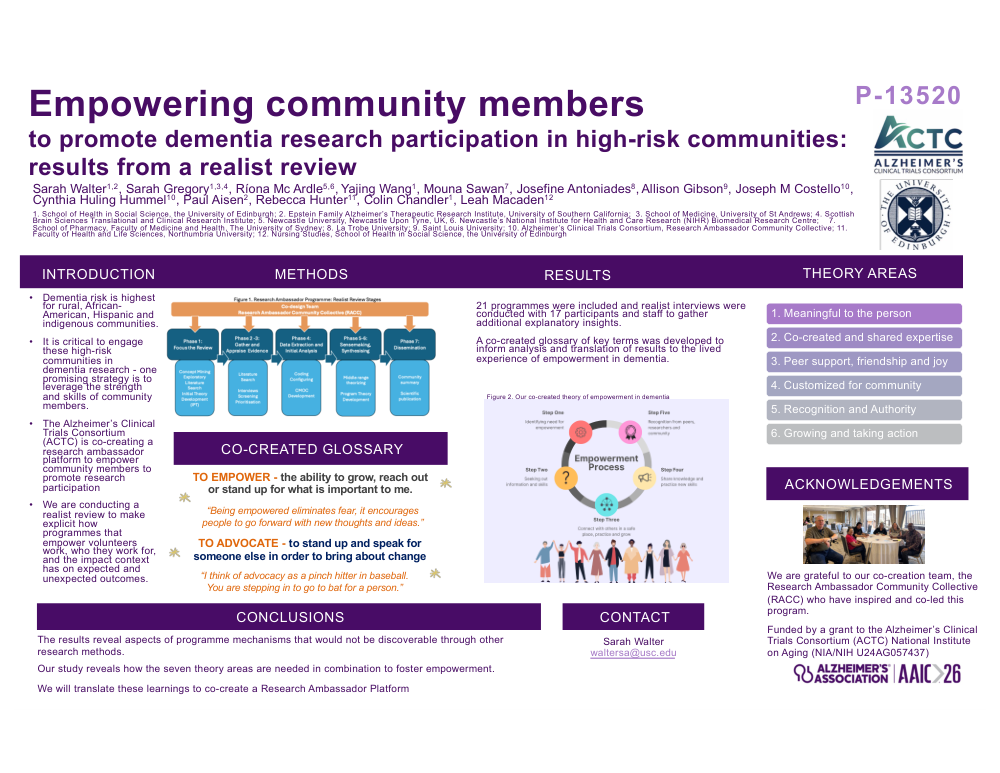
Every step of this project is being conducted in partnership with individuals that have lived experience of dementia, ACTC Research Ambassador Community Collective (RACC). Community-generated initial program theories were used to establish search terms and inclusion criteria. Systematic searches were conducted in medical databases and grey literature. A glossary of key terms has been co-created with the RACC to ensure programme theories are relevant and centered on lived experience. Realist interviewing and Realist methods of analysis were applied, developing context-mechanism-outcome configurations (CMOcs). This realist review protocol has been registered with PROSPERO [CRD420251072956].
CO-CREATED GLOSSARY
TO EMPOWER - the ability to grow, reach out or stand up for what is important to me.
“Being empowered eliminates fear, it encourages people to go forward with new thoughts and ideas.”
TO ADVOCATE - to stand up and speak for someone else in order to bring about change
“I think of advocacy as a pinch hitter in baseball. You are stepping in to go to bat for a person.”
RESULTS
21 programmes were included and realist interviews were conducted with 17 participants and staff to gather additional explanatory insights.
A co-created glossary of key terms was developed to inform analysis and translation of results to the lived experience of empowerment in dementia.
Figure 2. Our co-created theory of empowerment in dementia
THEORY AREAS
The results reveal aspects of programme mechanisms that would not be discoverable through other research methods.
Our study reveals how the seven theory areas are needed in combination to foster empowerment.
We will translate these learnings to co-create a Research Ambassador Platform
CONTACT
Sarah Walter waltersa@usc.edu
ACKNOWLEDGEMENTS
We are grateful to our co-creation team, the Research Ambassador Community Collective (RACC) who have inspired and co-led this program.
Funded by a grant to the Alzheimer’s Clinical Trials Consortium (ACTC) National Institute on Aging (NIA/NIH U24AG057437)
Comments
Email is required but is not shown publicly.
Loading comments...