4,068 posters, 219 videos, 101 topics, 69 sessions, 14,365 authors, 6,128 institutions
ePostersLive by SciGen Technologies S.A. All rights reserved.
Alzheimer's Association International Conference 2026
July 12-15, 2026 | London, United Kingdom, and Online

13454
Analysis Of Reddit Discourse On Novel Dementia Treatments: A Retrospective Observational Study
Poster Presenter
Authors
Zain Hussain, Mysha Sajid, Muhammed Shaan Riaz, Ayaz Sajid, Filippo Queirazza, Fani Deligianni, Amir Hussain, Aziz Sheikh, Craig Ritchie, Jonathan Cavanagh
Affiliations
University College London, University of Oxford, Scottish Brain Sciences; University of St Andrews, University of Glasgow, SUNY Binghamton University, Bethlehem Central High School, King Fahd University of Petroleum and Minerals
Part of Topic
Dementia Care and Psychosocial Factors -> Dementia Care and Health Services Research -> Healthcare information and technology (e.g., real-world data, health information exchange, AI in healthcare, patient registry)
Analysis of Reddit Discourse on Novel Dementia Treatments: A Retrospective Observational Study
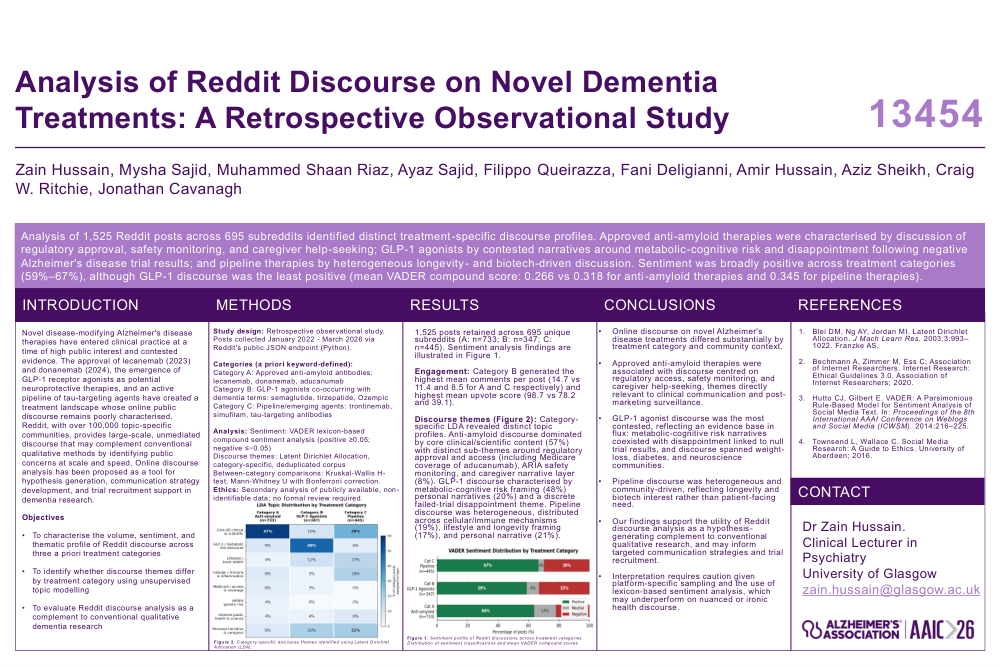
Analysis of 1,525 Reddit posts across 695 subreddits identified distinct treatment-specific discourse profiles. Approved anti-amyloid therapies were characterised by discussion of regulatory approval, safety monitoring, and caregiver help-seeking; GLP-1 agonists by contested narratives around metabolic-cognitive risk and disappointment following negative Alzheimer's disease trial results; and pipeline therapies by heterogeneous longevity- and biotech-driven discussion. Sentiment was broadly positive across treatment categories (59%–67%), although GLP-1 discourse was the least positive (mean VADER compound score: 0.266 vs 0.318 for anti-amyloid therapies and 0.345 for pipeline therapies).
Introduction:
Novel disease-modifying Alzheimer's disease therapies have entered clinical practice at a time of high public interest and contested evidence. The approval of lecanemab (2023) and donanemab (2024), the emergence of GLP-1 receptor agonists as potential neuroprotective therapies, and an active pipeline of tau-targeting agents have created a treatment landscape whose online public discourse remains poorly characterised. Reddit, with over 100,000 topic-specific communities, provides large-scale, unmediated discourse that may complement conventional qualitative methods by identifying public concerns at scale and speed. Online discourse analysis has been proposed as a tool for hypothesis generation, communication strategy development, and trial recruitment support in dementia research.
Objectives
Methods:
Study design: Retrospective observational study. Posts collected January 2022 - March 2026 via Reddit's public JSON endpoint (Python).
Categories (a priori keyword-defined):
Category A: Approved anti-amyloid antibodies: lecanemab, donanemab, aducanumab
Category B: GLP-1 agonists co-occurring with dementia terms: semaglutide, tirzepatide, Ozempic
Category C: Pipeline/emerging agents: trontinemab, simufilam, tau-targeting antibodies
Analysis: Sentiment: VADER lexicon-based compound sentiment analysis (positive ≥0.05; negative ≤−0.05)
Discourse themes: Latent Dirichlet Allocation, category-specific, deduplicated corpus
Between-category comparisons: Kruskal-Wallis H-test; Mann-Whitney U with Bonferroni correction. Ethics: Secondary analysis of publicly available, non-identifiable data; no formal review required.
Results:
1,525 posts retained across 695 unique subreddits (A: n=733; B: n=347; C: n=445). Sentiment analysis findings are illustrated in Figure 1.
Engagement: Category B generated the highest mean comments per post (14.7 vs 11.4 and 8.5 for A and C respectively) and highest mean upvote score (98.7 vs 78.2 and 39.1).
Discourse themes (Figure 2): Category-specific LDA revealed distinct topic profiles. Anti-amyloid discourse dominated by core clinical/scientific content (57%) with distinct sub-themes around regulatory approval and access (including Medicare coverage of aducanumab), ARIA safety monitoring, and caregiver narrative layer (8%). GLP-1 discourse characterised by metabolic-cognitive risk framing (48%) personal narratives (20%) and a discrete failed-trial disappointment theme. Pipeline discourse was heterogeneous, distributed across cellular/immune mechanisms (19%), lifestyle and longevity framing (17%), and personal narrative (21%).
Conclusions:
Comments
Email is required but is not shown publicly.
Loading comments...