4,068 posters, 219 videos, 101 topics, 69 sessions, 14,365 authors, 6,128 institutions
ePostersLive by SciGen Technologies S.A. All rights reserved.
Alzheimer's Association International Conference 2026
July 12-15, 2026 | London, United Kingdom, and Online

13088
Serious Games For Home Telemonitoring: Links To Cognition And RsEEG In Aging And Alzheimer’S Disease
Poster Presenter
Authors
Roberta Lizio, Claudio Del Percio, Matteo Carpi, Mina De Bartolo, Giuseppe Noce, Susanna Lopez, Veronica Henao Isaza, Burcu Bolukbas, Paolo Barone, Arianna Cappiello, Angelo Antonini, Eleonora Fiorenzato, Simone Cauzzo, Fabrizio Stocchi, Chiara Coletti, Giacomo Maria Russo, Andrea Rosati, Franco Giubilei, Claudio Babiloni
Affiliations
IRCCS Synlab SDN, Naples, Italy, Department of Physiology and Pharmacology “V Erspamer”, Sapienza University of Rome, Rome, Italy, Center for Neurodegenerative Diseases-CEMAND, UNISA, Salerno, Italy, Department of Neuroscience, University of Padua, Padua, Italy, IRCCS San Raffaele Rome, Rome, Italy, Sentech s.r.l., Sogetel s.r.l., Dep. of Neuroscience, Mental Health, and Sensory Organs, Sapienza University of Rome, Rome, Italy
Part of Topic
Dementia Care and Psychosocial Factors -> Dementia Care and Health Services Research -> Digital and mobile health (e.g., telemedicine, virtual care, remote monitoring)
Background: Unsupervised serious video games delivered through the SmartMe&You-TELEMAIA home telemonitoring platform (https://smartme.cloud.garr.it/) may provide a practical approach to track cognitive fluctuations in older adults with or without impairment. This study evaluated their validity in cognitively unimpaired individuals (Healthy) and in patients with mild cognitive impairment and mild-to-moderate Alzheimer’s disease–related dementia (ADCD).
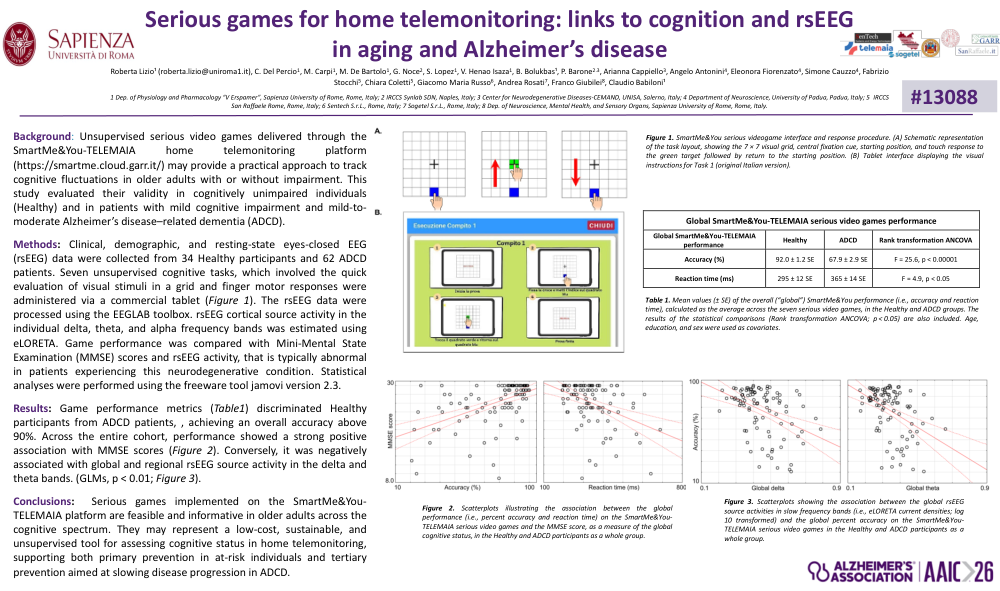
Methods: Clinical, demographic, and resting-state eyes-closed EEG (rsEEG) data were collected from 34 Healthy participants and 62 ADCD patients. Seven unsupervised cognitive tasks, which involved the quick evaluation of visual stimuli in a grid and finger motor responses were administered via a commercial tablet (Figure 1). The rsEEG data were processed using the EEGLAB toolbox. rsEEG cortical source activity in the individual delta, theta, and alpha frequency bands was estimated using eLORETA. Game performance was compared with Mini-Mental State Examination (MMSE) scores and rsEEG activity, that is typically abnormal in patients experiencing this neurodegenerative condition. Statistical analyses were performed using the freeware tool jamovi version 2.3.
Results: Game performance metrics (Table1) discriminated Healthy participants from ADCD patients, , achieving an overall accuracy above 90%. Across the entire cohort, performance showed a strong positive association with MMSE scores (Figure 2). Conversely, it was negatively associated with global and regional rsEEG source activity in the delta and theta bands. (GLMs, p < 0.01; Figure 3).
Conclusions: Serious games implemented on the SmartMe&You-TELEMAIA platform are feasible and informative in older adults across the cognitive spectrum. They may represent a low-cost, sustainable, and unsupervised tool for assessing cognitive status in home telemonitoring, supporting both primary prevention in at-risk individuals and tertiary prevention aimed at slowing disease progression in ADCD.
Comments
Email is required but is not shown publicly.
Loading comments...