Loading...

4,068 posters, 219 videos, 101 topics, 69 sessions, 14,365 authors, 6,128 institutions

ePostersLive by SciGen Technologies S.A. All rights reserved.

Alzheimer's Association International Conference 2026

July 12-15, 2026 | London, United Kingdom, and Online

Alzheimer's Association International Conference 2026 banner

12825

Trends And Disparities In Alzheimer’s Disease Related Mortality In U.S. Postmenopausal Women, With Forecasts To 2035: A Nationwide Study
Part of Topic

Dementia Care and Psychosocial Factors -> Dementia Care and Health Services Research -> Health and healthcare disparities

Introduction:

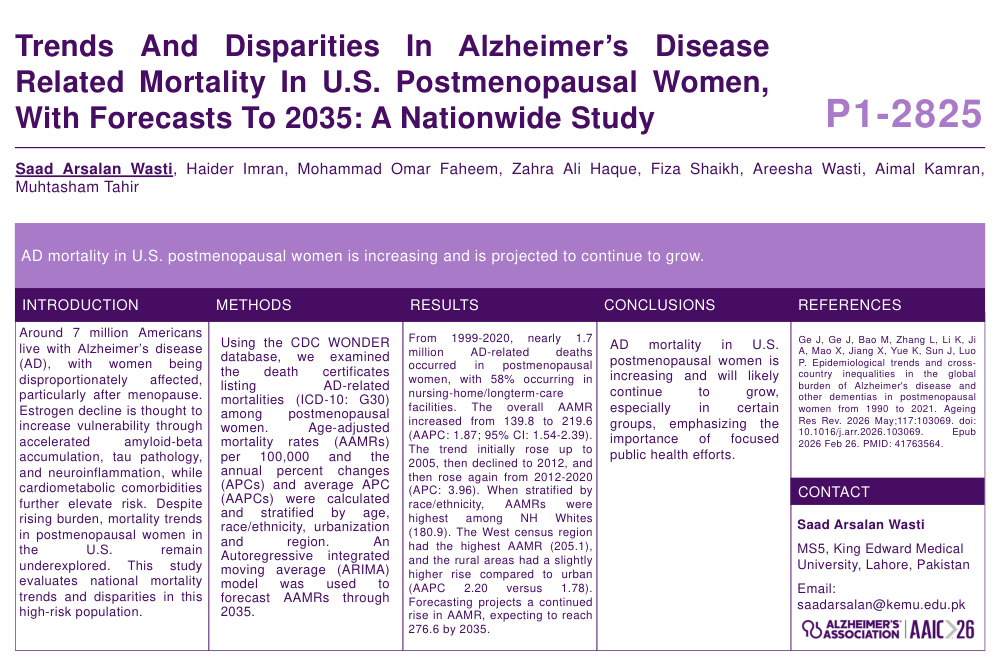
Around 7 million Americans live with Alzheimer’s disease (AD), with women being disproportionately affected, particularly after menopause. Estrogen decline is thought to increase vulnerability through accelerated amyloid-beta accumulation, tau pathology, and neuroinflammation, while cardiometabolic comorbidities further elevate risk. Despite rising burden, mortality trends in postmenopausal women in the U.S. remain underexplored. This study evaluates national mortality trends and disparities in this high-risk population.

Methods:
Using the CDC WONDER database, we examined the death certificates listing AD-related mortalities (ICD-10: G30) among postmenopausal women. Age-adjusted mortality rates (AAMRs) per 100,000 and the annual percent changes (APCs) and average APC (AAPCs) were calculated and stratified by age, race/ethnicity, urbanization and region. An Autoregressive integrated moving average (ARIMA) model was used to forecast AAMRs through 2035.
 
Results:
From 1999-2020, nearly 1.7 million AD-related deaths occurred in postmenopausal women, with 58% occurring in nursing-home/longterm-care facilities. The overall AAMR increased from 139.8 to 219.6 (AAPC: 1.87; 95% CI: 1.54-2.39). The trend initially rose up to 2005, then declined to 2012, and then rose again from 2012-2020 (APC: 3.96). When stratified by race/ethnicity, AAMRs were highest among NH Whites (180.9). The West census region had the highest AAMR (205.1), and the rural areas had a slightly higher rise compared to urban (AAPC 2.20 versus 1.78). Forecasting projects a continued rise in AAMR, expecting to reach 276.6 by 2035.
 
Conclusions:
AD mortality in U.S. postmenopausal women is increasing and will likely continue to grow, especially in certain groups, emphasizing the importance of focused public health efforts.


Comments

Email is required but is not shown publicly.

Loading comments...

aaic2026 banner
Copyright © 2015-2026, ePostersLive® SciGen is a registered trademark of SciGen Technologies S.A. Patent pending.

This website and third-party tools we use rely on cookies for the best user experience. By selecting "I agree", you agree to cookie usage as described in our Privacy Policy.