4,068 posters, 219 videos, 101 topics, 69 sessions, 14,365 authors, 6,128 institutions
ePostersLive by SciGen Technologies S.A. All rights reserved.
Alzheimer's Association International Conference 2026
July 12-15, 2026 | London, United Kingdom, and Online

11993
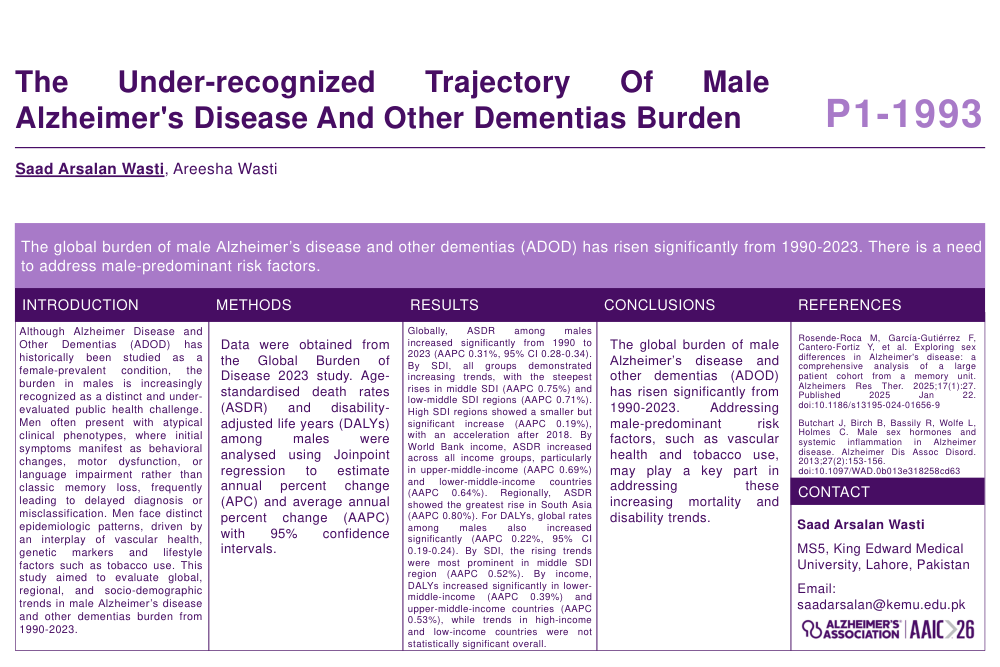
The Under-recognized Trajectory Of Male Alzheimer's Disease And Other Dementias Burden
Poster Presenter
Authors
Part of Topic
Dementia Care and Psychosocial Factors -> Dementia Care and Health Services Research -> Health and healthcare disparities
Introduction:
Although Alzheimer Disease and Other Dementias (ADOD) has historically been studied as a female-prevalent condition, the burden in males is increasingly recognized as a distinct and under-evaluated public health challenge. Men often present with atypical clinical phenotypes, where initial symptoms manifest as behavioral changes, motor dysfunction, or language impairment rather than classic memory loss, frequently leading to delayed diagnosis or misclassification. Men face distinct epidemiologic patterns, driven by an interplay of vascular health, genetic markers and lifestyle factors such as tobacco use. This study aimed to evaluate global, regional, and socio-demographic trends in male Alzheimer’s disease and other dementias burden from 1990-2023.
Methods:
Data were obtained from the Global Burden of Disease 2023 study. Age-standardised death rates (ASDR) and disability-adjusted life years (DALYs) among males were analysed using Joinpoint regression to estimate annual percent change (APC) and average annual percent change (AAPC) with 95% confidence intervals.
Results:
Globally, ASDR among males increased significantly from 1990 to 2023 (AAPC 0.31%, 95% CI 0.28-0.34). By SDI, all groups demonstrated increasing trends, with the steepest rises in middle SDI (AAPC 0.75%) and low-middle SDI regions (AAPC 0.71%). High SDI regions showed a smaller but significant increase (AAPC 0.19%), with an acceleration after 2018. By World Bank income, ASDR increased across all income groups, particularly in upper-middle-income (AAPC 0.69%) and lower-middle-income countries (AAPC 0.64%). Regionally, ASDR showed the greatest rise in South Asia (AAPC 0.80%). For DALYs, global rates among males also increased significantly (AAPC 0.22%, 95% CI 0.19-0.24). By SDI, the rising trends were most prominent in middle SDI region (AAPC 0.52%). By income, DALYs increased significantly in lower-middle-income (AAPC 0.39%) and upper-middle-income countries (AAPC 0.53%), while trends in high-income and low-income countries were not statistically significant overall.
Conclusions:
The global burden of male Alzheimer’s disease and other dementias (ADOD) has risen significantly from 1990-2023. Addressing male-predominant risk factors, such as vascular health and tobacco use, may play a key part in addressing these increasing mortality and disability trends.
Comments
Email is required but is not shown publicly.
Loading comments...