4,068 posters, 219 videos, 101 topics, 69 sessions, 14,365 authors, 6,128 institutions
ePostersLive by SciGen Technologies S.A. All rights reserved.
Alzheimer's Association International Conference 2026
July 12-15, 2026 | London, United Kingdom, and Online

4092
Heterogeneous Treatment Effects Of Proton Pump Inhibitors On Dementia Risk: Using Causal Machine Learning And Real-world Data
Poster Presenter
Authors
Part of Topic
Dementia Care and Psychosocial Factors -> Dementia Care and Health Services Research -> Implementation science and healthcare innovation
BACKGROUNDS
Previous studies of proton pump inhibitors (PPIs) and dementia have reported inconsistent results. Whether PPIs affect dementia risk and whether such effects vary across subgroups remains unclear. We applied the high-dimensional iterative causal forest (hdiCF) machine learning subgrouping algorithm to assess heterogeneous treatment effects (HTEs) of PPIs on dementia.
METHODS
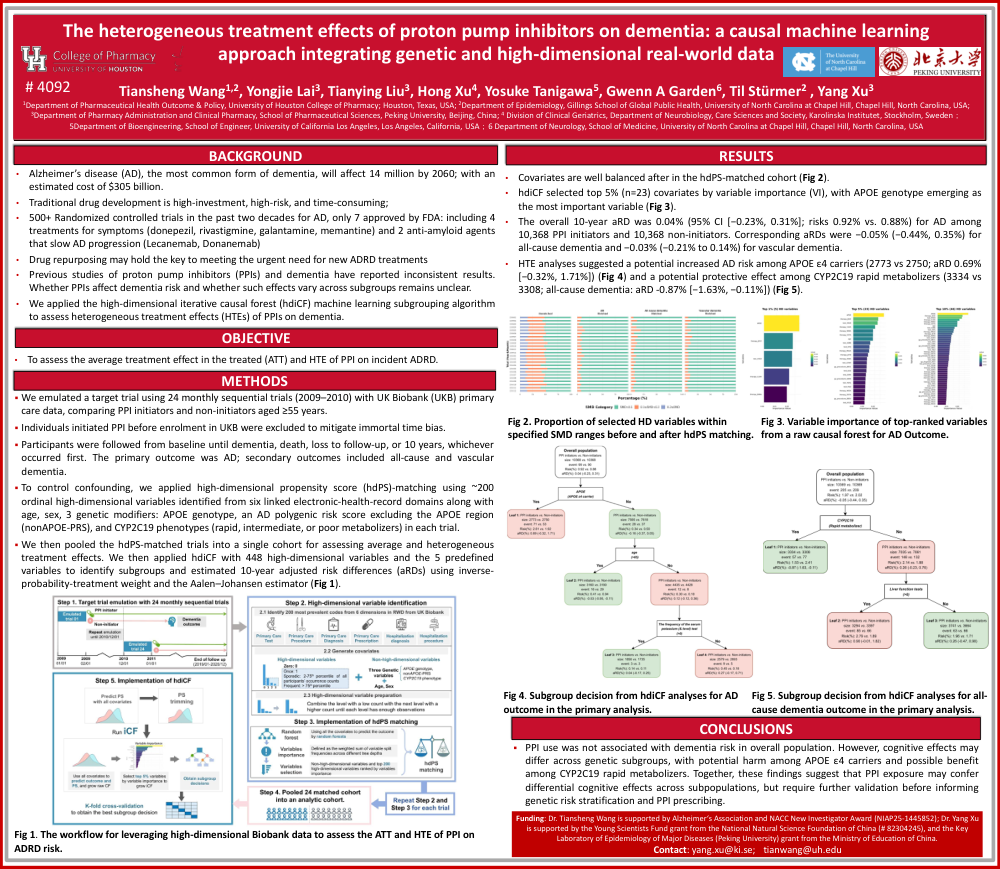
We emulated a target trial using 24 monthly sequential trials (2009–2010) with UK Biobank (UKB) primary care data, comparing PPI initiators and non-initiators aged ≥55 years. Individuals initiated PPI before enrolment in UKB were excluded to mitigate immortal time bias. Participants were followed from baseline until dementia, death, loss to follow-up, or 10 years, whichever occurred first. The primary outcome was Alzheimer’s disease (AD); secondary outcomes included all-cause and vascular dementia.
To control confounding, we applied high-dimensional propensity score (hdPS)-matching using ~200 ordinal high-dimensional variables identified from six linked electronic-health-record domains along with age, sex, 3 genetic modifiers: APOE genotype, an AD polygenic risk score excluding the APOE region (nonAPOE-PRS), and CYP2C19 phenotypes (rapid, intermediate, or poor metabolizers) in each trial. We then pooled the hdPS-matched trials into a single cohort for assessing average and heterogeneous treatment effects.
We then applied hdiCF with 448 high-dimensional variables and the 5 predefined variables to identify subgroups and estimated 10-year adjusted risk differences (aRDs) using inverse-probability-treatment weight and the Aalen–Johansen estimator.
RESULTS
The overall 10-year aRD was 0.04% (95% CI [−0.23%, 0.31%]; risks 0.92% vs. 0.88%) for AD among 10,368 PPI initiators and 10,368 non-initiators. Corresponding aRDs were −0.05% (−0.44%, 0.35%) for all-cause dementia and −0.03% (−0.21% to 0.14%) for vascular dementia.
HTE analyses suggested a potential increased AD risk among APOE ε4 carriers (2773 vs 2750; aRD 0.69% [−0.32%, 1.71%]) and a potential protective effect among CYP2C19 rapid metabolizers (3334 vs 3308; all-cause dementia: aRD -0.87% [−1.63%, −0.11%]).
CONCLUSIONS
PPI use was not associated with dementia risk in overall population. However, cognitive effects may differ across genetic subgroups, with potential harm among APOE ε4 carriers and possible benefit among CYP2C19 rapid metabolizers. Together, these findings suggest that PPI exposure may confer differential cognitive effects across subpopulations, but require further validation before informing genetic risk stratification and PPI prescribing.
Comments
Email is required but is not shown publicly.
Loading comments...