4,068 posters, 219 videos, 101 topics, 69 sessions, 14,365 authors, 6,128 institutions
ePostersLive by SciGen Technologies S.A. All rights reserved.
Alzheimer's Association International Conference 2026
July 12-15, 2026 | London, United Kingdom, and Online

2199
Antibody Treatment And Early Detection Of Dementia - How Prepared Are Germany's Specialists?
Part of Topic
Dementia Care and Psychosocial Factors -> Dementia Care and Health Services Research -> Healthcare access, delivery, and quality
Introduction:
-Early detection of dementia can help to reduce risk factors [1], support early care planning and apply (non-) pharmacological treatment [2, 3]
-Antibody treatments are now available in Germany (Leqembi & Kinsula)
- Preparedness of German specialists for expanded The study investigates current practices in the early detection and diagnosis of dementia in Germany
-> the study explores German specialists’ perspectives on the introduction of new antibody therapies for dementia
Methods:
•Online survey among German specialist doctors from memory clincs and private practices
Recruitment:
•from September 2024 to February 2025:
ØEmail invitation distributed to n=1293 neurologist and psychiatrists
ØStudy advertisement at congresses
ØPress releases in physicians’ newspapers
Survey’s content:
•Attitude towards early detection & antibody treatment
•Application of biomarker-based diagnostics
•Diagnostic routines and applied diagnostic tools
Evaluation method:
•Descriptive statistical analysis
Results:
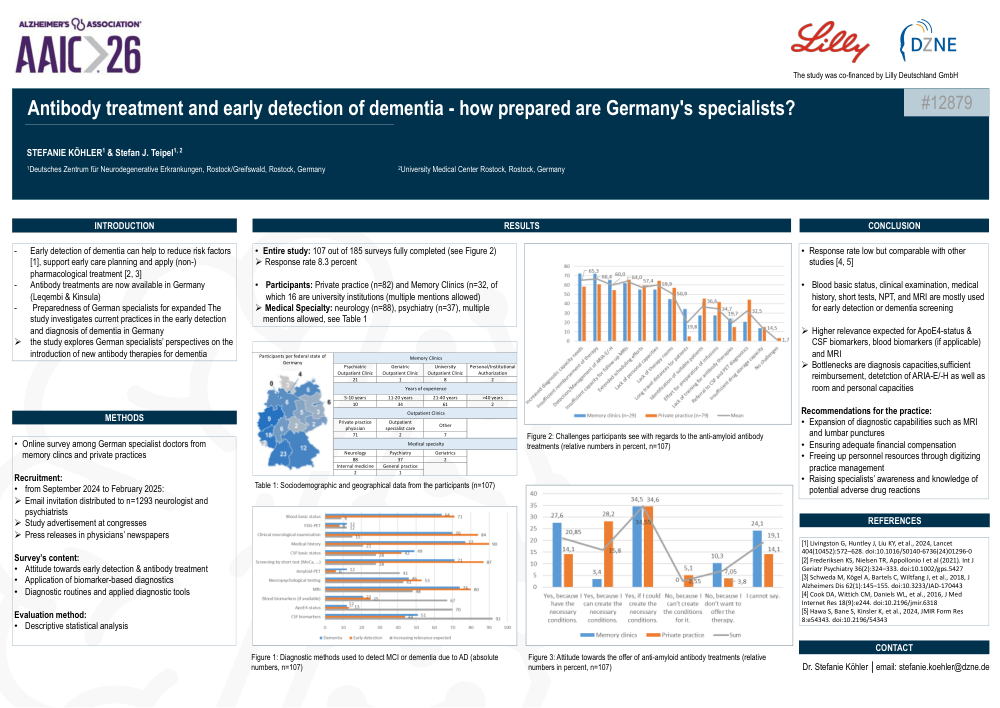
•Entire study: 107 out of 185 surveys fully completed (see Figure 2 at the poster)
-> Response rate 8.3 percent
•Participants: Private practice (n=82) and Memory Clinics (n=32, of which 16 are university institutions (multiple mentions allowed)
-> Medical Specialty: neurology (n=88), psychiatry (n=37), multiple mentions allowed, see Table 1at the poster
Conclusion:
•Response rate low but comparable with other studies [4, 5]
•
•Blood basic status, clinical examination, medical history, short tests, NPT, and MRI are mostly used for early detection or dementia screening
-> Higher relevance expected for ApoE4-status & CSF biomarkers, blood biomarkers (if applicable) and MRI
-> Bottlenecks are diagnosis capacities,sufficient reimbursement, detetction of ARIA-E/-H as well as room and personal capacities
Recommendations for the practice:
•Expansion of diagnostic capabilities such as MRI and lumbar punctures
•Ensuring adequate financial compensation
•Freeing up personnel resources through digitizing practice management
•Raising specialists’ awareness and knowledge of potential adverse drug reactions
Comments
Email is required but is not shown publicly.
Loading comments...