4,068 posters, 219 videos, 101 topics, 69 sessions, 14,365 authors, 6,128 institutions
ePostersLive by SciGen Technologies S.A. All rights reserved.
Alzheimer's Association International Conference 2026
July 12-15, 2026 | London, United Kingdom, and Online

13245
The Reasons For Not Receiving Anti-aί Therapy In Alzheimer's Disease Patients In Northwest China
Poster Presenter
Authors
Xiaojuan Guo, Peijie Liu, Simeng Cui, Yan Qu, Jing Wang, Qiumin Qu, Jie Liu
Affiliations
Part of Topic
Dementia Care and Psychosocial Factors -> Dementia Care and Health Services Research -> Healthcare utilization and costs
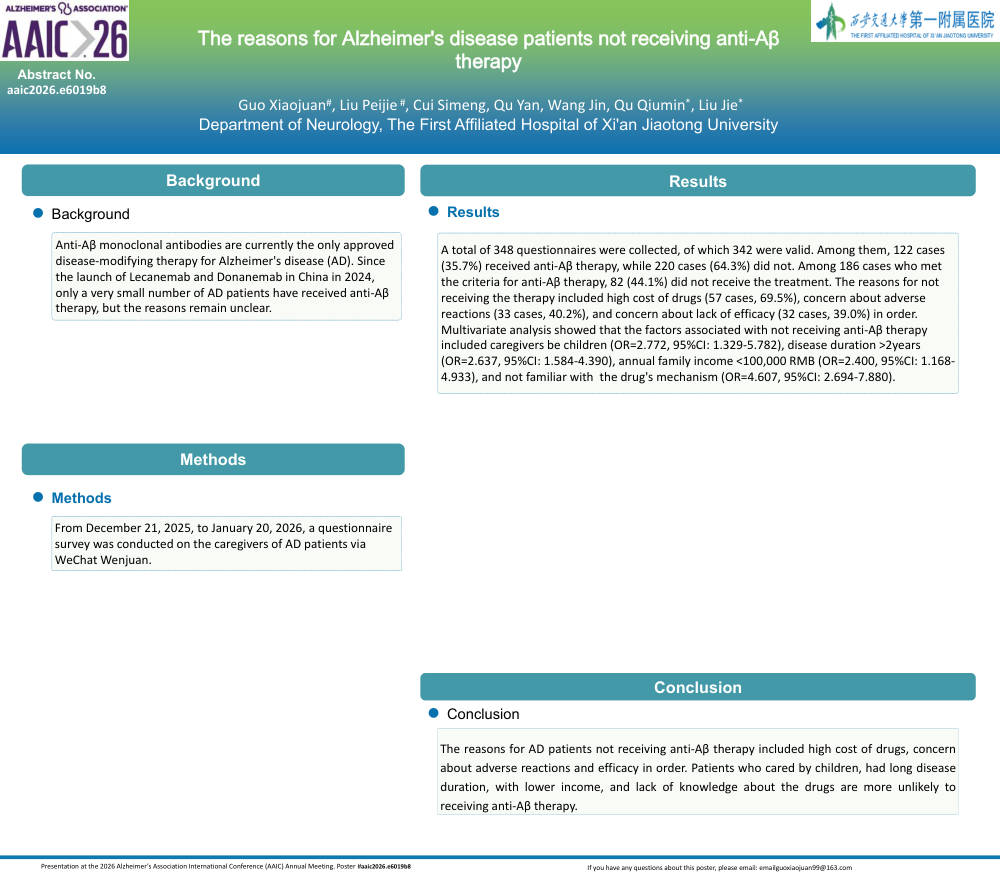
Background: Anti-Aβ monoclonal antibodies are currently the only approved disease-modifying therapy for Alzheimer's disease (AD). Since the launch of Lecanemab and Donanemab in China in 2024, only a very small number of AD patients have received anti-Aβ therapy, but the reasons remain unclear.
Methods: From December 21, 2025, to January 20, 2026, a questionnaire survey was conducted on the caregivers of AD patients via WeChat Wenjuan.
Results: A total of 348 questionnaires were collected, of which 342 were valid. Among them, 122 cases (35.7%) received anti-Aβ therapy, while 220 cases (64.3%) did not. Among 186 cases who met the criteria for anti-Aβ therapy, 82 (44.1%) did not receive the treatment. The reasons for not receiving the therapy included high cost of drugs (57 cases, 69.5%), concern about adverse reactions (33 cases, 40.2%), and concern about lack of efficacy (32 cases, 39.0%) in order. Multivariate analysis showed that the factors associated with not receiving anti-Aβ therapy included caregivers be children (OR=2.772, 95%CI: 1.329-5.782), disease duration >2years (OR=2.637, 95%CI: 1.584-4.390), annual family income <100,000 RMB (OR=2.400, 95%CI: 1.168-4.933), and not familiar with the drug's mechanism (OR=4.607, 95%CI: 2.694-7.880).
Conclusion: The reasons for AD patients not receiving anti-Aβ therapy included high cost of drugs, concern about adverse reactions and efficacy in order. Patients who cared by children, had long disease duration, with lower income, and lack of knowledge about the drugs are more unlikely to receiving anti-Aβ therapy.
Comments
Email is required but is not shown publicly.
Loading comments...