4,068 posters, 219 videos, 101 topics, 69 sessions, 14,365 authors, 6,128 institutions
ePostersLive by SciGen Technologies S.A. All rights reserved.
Alzheimer's Association International Conference 2026
July 12-15, 2026 | London, United Kingdom, and Online

13362
The CLEAR Team Protocol: A Randomized Controlled Trial Of A Streamlined Approach To Amyloid-targeting Therapy Evaluation
Poster Presenter
Part of Topic
Dementia Care and Psychosocial Factors -> Dementia Care Practice -> Innovative programs and practices
Title: The CLEAR Team Protocol: A Randomized Controlled Trial of a Streamlined Approach to Amyloid-Targeting Therapy Screening
Authors: Sungwoo Moon, Hairong Wang PhD, Shaye A. Kerper MPH, Patrick MacIntyre, Rachel San Pedro LSW RN, Xingyu (Mark) Zhang PhD, Steven M. Handler MD PhD, Julie Faieta PhD OTR/L, Alison J. O'Donnell DO
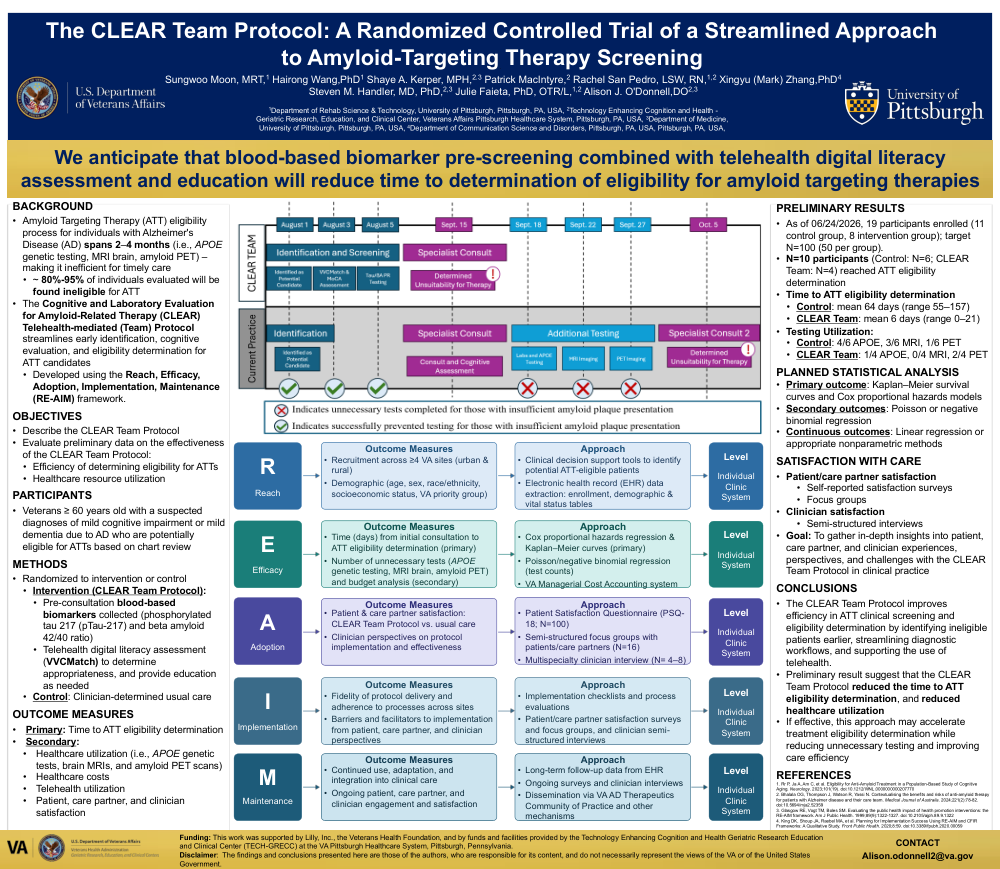
Hypothesis. Blood-based biomarker pre-screening combined with telehealth digital literacy assessment and education will reduce time to determination of eligibility for amyloid targeting therapies.
Background. The ATT eligibility process for individuals with Alzheimer's Disease spans 2–4 months, including APOE genetic testing, MRI brain, and amyloid PET, making it inefficient for timely care. Approximately 80–95% of individuals evaluated will be found ineligible for ATT. The Cognitive and Laboratory Evaluation for Amyloid-Related Therapy (CLEAR) Telehealth-mediated (Team) Protocol streamlines early identification, cognitive evaluation, and eligibility determination for ATT candidates. The protocol was developed using the Reach, Efficacy, Adoption, Implementation, Maintenance (RE-AIM) framework.
Objectives. Describe the CLEAR Team Protocol and evaluate preliminary data on its effectiveness, including efficiency of determining eligibility for ATTs and healthcare resource utilization.
Participants. Veterans 60 years of age or older with a suspected diagnosis of mild cognitive impairment or mild dementia due to Alzheimer's Disease who are potentially eligible for ATTs based on chart review.
Methods. Participants were randomized to intervention or control. The intervention (CLEAR Team Protocol) included pre-consultation blood-based biomarkers (phosphorylated tau 217 [pTau-217] and beta amyloid 42/40 ratio) and a telehealth digital literacy assessment (VVCMatch) to determine appropriateness and provide education as needed. The control condition was clinician-determined usual care.
Outcome Measures. Primary: Time to ATT eligibility determination. Secondary: healthcare utilization (APOE genetic tests, brain MRIs, and amyloid PET scans), healthcare costs, telehealth utilization, and patient, care partner, and clinician satisfaction.
Preliminary Results. As of 06/24/2026, 19 participants were enrolled (11 control, 8 intervention); target N=100 (50 per group). Ten participants (Control: N=6; CLEAR Team: N=4) reached ATT eligibility determination. Time to ATT eligibility determination: Control mean 64 days (range 55–157); CLEAR Team mean 6 days (range 0–21). Testing utilization: Control 4/6 APOE, 3/6 MRI, 1/6 PET; CLEAR Team 1/4 APOE, 0/4 MRI, 2/4 PET.
Planned Statistical Analysis. Primary outcome: Kaplan–Meier survival curves and Cox proportional hazards models. Secondary outcomes: Poisson or negative binomial regression. Continuous outcomes: linear regression or appropriate nonparametric methods.
Conclusions. The CLEAR Team Protocol is designed to improve efficiency in ATT clinical screening and eligibility determination. Preliminary results suggest the protocol reduced time to ATT eligibility determination and reduced healthcare utilization. If effective, this approach may accelerate treatment eligibility determination while reducing unnecessary testing and improving care efficiency.
Funding. This work was supported by Lilly, Inc., the Veterans Health Foundation, and by funds and facilities provided by the Technology Enhancing Cognition and Health Geriatric Research Education and Clinical Center (TECH-GRECC) at the VA Pittsburgh Healthcare System, Pittsburgh, Pennsylvania.
Disclaimer. The findings and conclusions presented are those of the authors and do not necessarily represent the views of the VA or the United States Government.
Comments
Email is required but is not shown publicly.
Loading comments...