Loading...

4,068 posters, 219 videos, 101 topics, 69 sessions, 14,365 authors, 6,128 institutions

ePostersLive by SciGen Technologies S.A. All rights reserved.

Alzheimer's Association International Conference 2026

July 12-15, 2026 | London, United Kingdom, and Online

Alzheimer's Association International Conference 2026 banner

12883

Results From The Geneva Brain Health Services For The Prevention Of Dementia
Poster Presenter

Ozge Sayin

Authors

Ozge Sayin

Affiliations

Part of Topic

Dementia Care and Psychosocial Factors -> Dementia Care and Health Services Research -> Prevention and risk reduction strategies

Results from the Geneva Brain Health Services for the prevention of dementia

Özge Sayin, Federica Ribaldi, Augusto J. Mendes, Giovanni B. Frisoni

Introduction:
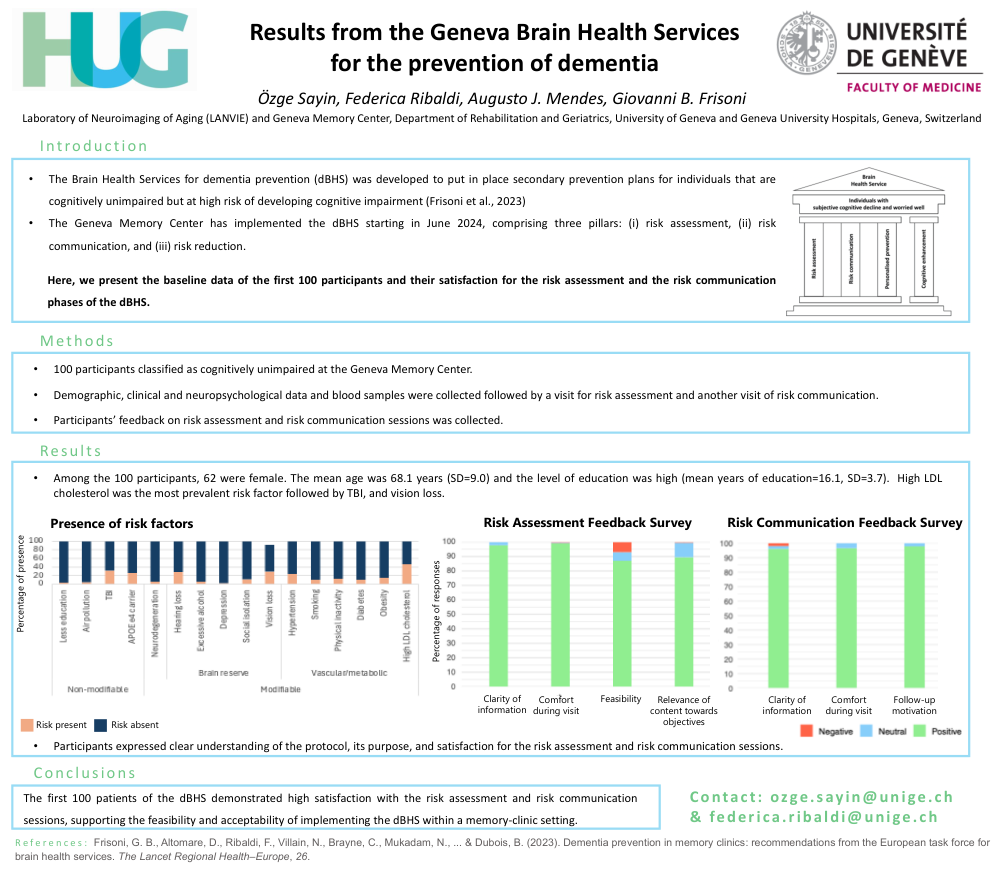
•The Brain Health Services for dementia prevention (dBHS) was developed to put in place secondary prevention plans for individuals that are cognitively unimpaired but at high risk of developing cognitive impairment (Frisoni et al., 2023)
•The Geneva Memory Center has implemented the dBHS starting in June 2024, comprising three pillars: (i) risk assessment, (ii) risk communication, and (iii) risk reduction.

Here, we present the baseline data of the first 100 participants and their satisfaction for the risk assessment and the risk communication phases of the dBHS.

Methods:

•100 participants classified as cognitively unimpaired at the Geneva Memory Center.

•Demographic, clinical and neuropsychological data and blood samples were collected followed by a visit for risk assessment and another visit of risk communication.

•Participants’ feedback on risk assessment and risk communication sessions was collected.
 
Results:
•Among the 100 participants, 62 were female. The mean age was 68.1 years (SD=9.0) and the level of education was high (mean years of education=16.1, SD=3.7).  High LDL cholesterol was the most prevalent risk factor followed by TBI, and vision loss.
 
•Participants expressed clear understanding of the protocol, its purpose, and satisfaction for the risk assessment and risk communication sessions.
 
Conclusions:
The first 100 patients of the dBHS demonstrated high satisfaction with the risk assessment and risk communication sessions, supporting the feasibility and acceptability of implementing the dBHS within a memory-clinic setting.

Comments

Email is required but is not shown publicly.

Loading comments...

aaic2026 banner
Copyright © 2015-2026, ePostersLive® SciGen is a registered trademark of SciGen Technologies S.A. Patent pending.

This website and third-party tools we use rely on cookies for the best user experience. By selecting "I agree", you agree to cookie usage as described in our Privacy Policy.