4,068 posters, 219 videos, 101 topics, 69 sessions, 14,365 authors, 6,128 institutions
ePostersLive by SciGen Technologies S.A. All rights reserved.
Alzheimer's Association International Conference 2026
July 12-15, 2026 | London, United Kingdom, and Online

11960
Quantification Of Benefit-risk In Amyloid-targeting Therapies For Cognitively Unimpaired Alzheimer's Disease
Poster Presenter
Authors
Oralee J Varnado, Matthew Quaife, Jaein Seo, Antje Tockhorn-Heidenreich, Nalin Payakachat, Yasmijn Slaghekke, Álvaro Alberto Gutiérrez-Vargas, J. Scott Andrews, Niklas Mattsson-Carlgren
Affiliations
Eli Lilly and Company, Indianapolis, IN, USA, PPD Evidera Patient-Centered Research, Thermo Fisher Scientific, London, UK, PPD Evidera Patient-Centered Research, Thermo Fisher Scientific, Waltham, MA, USA, Clinical Memory Research Unit, Department of Clinical Sciences Malmö, Medical Faculty, Lund University, Lund, Sweden; Memory Clinic, Skåne University Hospital, Malmö, Sweden
Part of Topic
Dementia Care and Psychosocial Factors -> Dementia Care and Health Services Research -> Person-centered,-partnered, or led research
Quantification of Benefit-Risk in Amyloid-Targeting Therapies for Cognitively Unimpaired Alzheimer's Disease
Oralee J Varnado1, Matthew Quaife2, Jaein Seo3, Antje Tockhorn-Heidenreich1, Nalin Payakachat1, Yasmijn Slaghekke2, Álvaro Alberto Gutiérrez-Vargas2,
J. Scott Andrews1, Niklas Mattsson-Carlgren4,5
1Eli Lilly and Company, Indianapolis, IN, USA
2PPD Evidera Patient-Centered Research, Thermo Fisher Scientific, London, UK
3PPD Evidera Patient-Centered Research, Thermo Fisher Scientific, Waltham, MA, USA
4Clinical Memory Research Unit, Department of Clinical Sciences Malmö, Medical Faculty, Lund University, Lund, Sweden
5Memory Clinic, Skåne University Hospital, Malmö, Sweden
Sponsored by Eli Lilly and Company
BACKGROUND
Study Aim
OBJECTIVES
STUDY DESIGN
KEY RESULT
Choosing Treatment
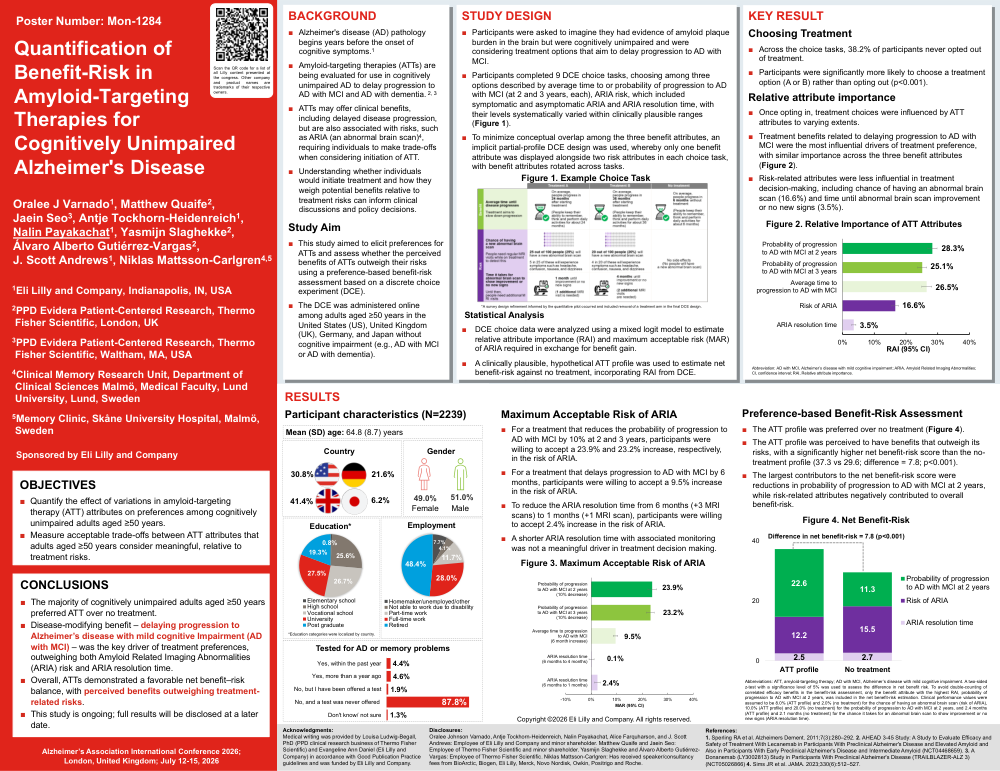
■Across the choice tasks, 38.2% of participants never opted out of treatment.
■Participants were significantly more likely to choose a treatment option (A or B) rather than opting out (p<0.001).
Relative attribute importance
■Once opting in, treatment choices were influenced by ATT attributes to varying extents.
■Treatment benefits related to delaying progression to AD with MCI were the most influential drivers of treatment preference, with similar importance across the three benefit attributes (Figure 2).
■Risk-related attributes were less influential in treatment decision-making, including chance of having an abnormal brain scan (16.6%) and time until abnormal brain scan improvement or no new signs (3.5%).
Maximum Acceptable Risk of ARIA
■For a treatment that reduces the probability of progression to AD with MCI by 10% at 2 and 3 years, participants were willing to accept a 23.9% and 23.2% increase, respectively, in the risk of ARIA.
■For a treatment that delays progression to AD with MCI by 6 months, participants were willing to accept a 9.5% increase in the risk of ARIA.
■To reduce the ARIA resolution time from 6 months (+3 MRI scans) to 1 months (+1 MRI scan), participants were willing to accept 2.4% increase in the risk of ARIA.
■A shorter ARIA resolution time with associated monitoring was not a meaningful driver in treatment decision making.
Preference-based Benefit-Risk Assessment
■The ATT profile was preferred over no treatment (Figure 4).
■The ATT profile was perceived to have benefits that outweigh its risks, with a significantly higher net benefit-risk score than the no-treatment profile (37.3 vs 29.6; difference = 7.8; p<0.001).
■The largest contributors to the net benefit-risk score were reductions in probability of progression to AD with MCI at 2 years, while risk-related attributes negatively contributed to overall benefit-risk.
CONCLUSIONS
Acknowledgments:
Medical writing was provided by Louisa Ludwig-Begall, PhD (PPD clinical research business of Thermo Fisher Scientific) and Evangeline Ann Daniel (Eli Lilly and Company) in accordance with Good Publication Practice guidelines and was funded by Eli Lilly and Company.
Disclosures:
Oralee Johnson Varnado, Antje Tockhorn-Heidenreich, Nalin Payakachat, Alice Farquharson, and J. Scott Andrews: Employee of Eli Lilly and Company and minor shareholder. Matthew Quaife and Jaein Seo: Employee of Thermo Fisher Scientific and minor shareholder. Yasmijn Slaghekke and Álvaro Alberto Gutiérrez-Vargas: Employee of Thermo Fisher Scientific. Niklas Mattsson-Carlgren: Has received speaker/consultancy fees from BioArctic, Biogen, Eli Lilly, Merck, Novo Nordisk, Owkin, Positrigo and Roche.
References:
1. Sperling RA et al. Alzheimers Dement. 2011;7(3):280–292.
2. AHEAD 3-45 Study: A Study to Evaluate Efficacy and Safety of Treatment With Lecanemab in Participants With Preclinical Alzheimer's Disease and Elevated Amyloid and Also in Participants With Early Preclinical Alzheimer's Disease and Intermediate Amyloid (NCT04468659).
3. A Donanemab (LY3002813) Study in Participants With Preclinical Alzheimer's Disease (TRAILBLAZER-ALZ 3) (NCT05026866)
4. Sims JR et al. JAMA. 2023;330(6):512–527.
Comments
Email is required but is not shown publicly.
Loading comments...