4,068 posters, 219 videos, 101 topics, 69 sessions, 14,365 authors, 6,128 institutions
ePostersLive by SciGen Technologies S.A. All rights reserved.
Alzheimer's Association International Conference 2026
July 12-15, 2026 | London, United Kingdom, and Online

12999
Promising Practices For Engaging People With Lived Experience Of Dementia In Advocacy And Research: Findings From A Modified Delphi Study
Poster Presenter
Authors
Belen Custodio, Ma. Florencia Clarens, Harriet Demnitz-King, Sherril Gelmon
Affiliations
Research Department, Instituto Peruano de Neurociencias, Lima, Peru, Department of Cognitive Neurology, Fleni, Buenos Aires, Argentina, Centre for Psychiatry and Mental Health, Queen Mary University of London, UK, OHSU-PSU School of Public Health, Portland State University, Portland, OR, USA
Part of Topic
Dementia Care and Psychosocial Factors -> Dementia Care and Health Services Research -> Person-centered,-partnered, or led research
Background: Meaningful engagement of individuals with lived experience of dementia is increasingly prioritized in advocacy and research, yet there is an absence of practical implementation guidance. We conducted a modified Delphi study to identify a consensus-based, international framework of promising practices to guide such efforts.
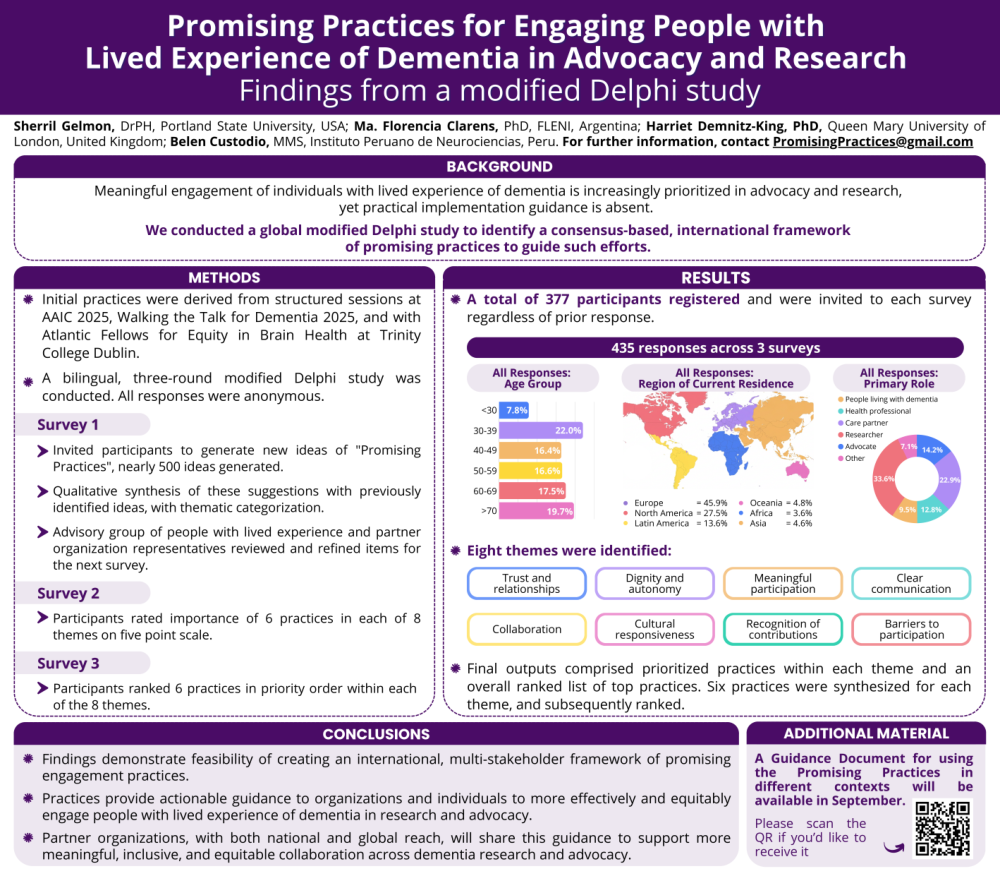
Methods: A bilingual, three-round modified Delphi study was conducted to identify and prioritize promising practices. Initial practices were derived from structured sessions at Alzheimer’s Association International Conference 2025, Walking the Talk for Dementia 2025, and with Atlantic Fellows for Equity in Brain Health at Trinity College Dublin. Survey 1 combined review of previously identified practices with open-text input for new ideas; responses underwent qualitative synthesis, duplication and thematic categorization. An advisory group, including people with lived experience and partner organization representatives, reviewed and refined items for the next survey. In Survey 2, participants rated each practice’s importance on a five-point scale. In Survey 3, participants ranked practices. All responses were anonymous.
Results: A total of 377 participants registered and were invited to each survey regardless of prior response. Respondents included researchers (30%), care partners (20%), people living with dementia (10%), with the remainder primarily advocates and health/social service professionals. The sample was globally distributed: Europe/UK (nearly 50%), North America (25%), Latin America (15%), Asia (5%), Oceania (5%), and Africa (3%), spanning all adult age groups.
Eight themes were identified: trust and relationships; dignity and autonomy; meaningful participation; clear communication; collaboration; cultural responsiveness; recognition of contributions; and barriers to participation. Final outputs comprised prioritized practices within each theme and an overall ranked list of top practices. Six practices were synthesized for each theme, and subsequently ranked.
Conclusion: Our findings demonstrate the feasibility of establishing an international, multi-stakeholder framework of promising engagement practices. These practices provide actionable guidance to organizations and individuals to more effectively and equitably engage people living with dementia and their care partners in research and advocacy. Partner organizations, with both national and global reach, plan to use this guidance to support more meaningful, inclusive, and equitable collaboration across dementia research and advocacy.
Comments
Email is required but is not shown publicly.
Loading comments...