4,068 posters, 219 videos, 101 topics, 69 sessions, 14,365 authors, 6,128 institutions
ePostersLive by SciGen Technologies S.A. All rights reserved.
Alzheimer's Association International Conference 2026
July 12-15, 2026 | London, United Kingdom, and Online

13717
Nationwide Real-world Analysis Of Memantine Use In Dementia: The Current Care Landscape In Hungary
Poster Presenter
Part of Topic
Dementia Care and Psychosocial Factors -> Dementia Care and Health Services Research -> Healthcare information and technology (e.g., real-world data, health information exchange, AI in healthcare, patient registry)
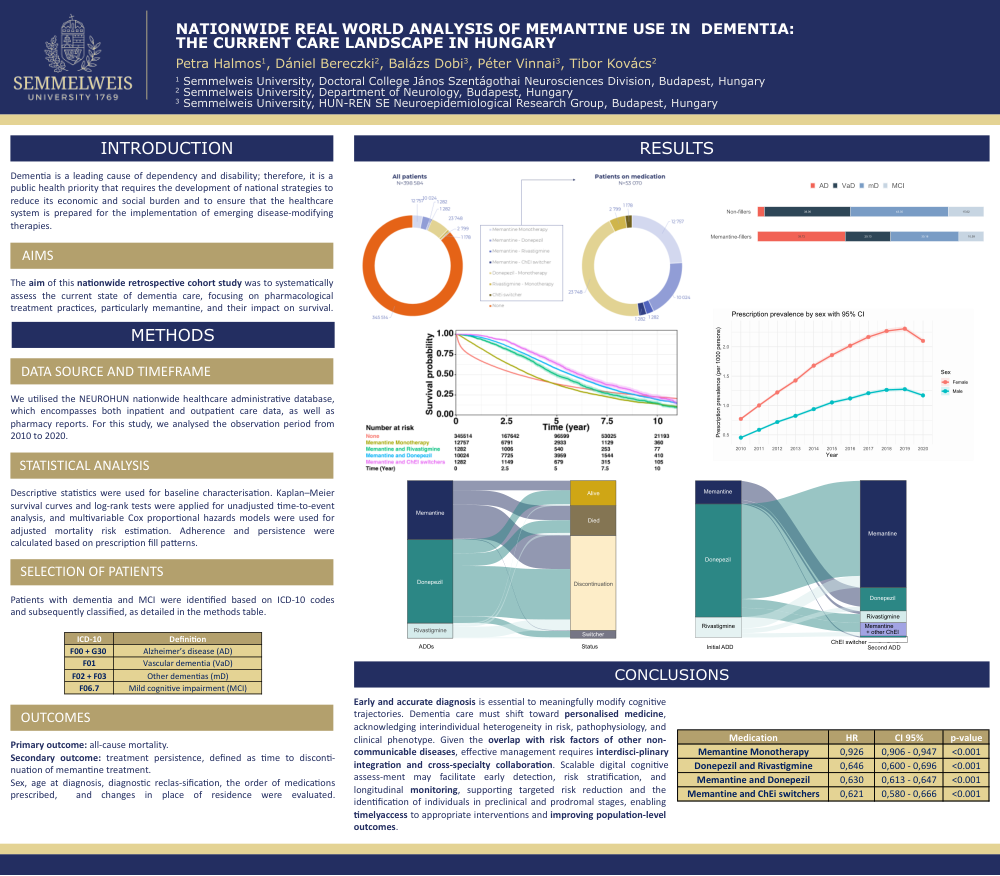
NATIONWIDE REAL WORLD ANALYSIS OF MEMANTINE USE IN DEMENTIA: THE CURRENT CARE LANDSCAPE IN HUNGARY
INTRODUCTION
Dementia is a leading cause of dependency and disability; therefore, it is a public health priority that requires the development of national strategies to reduce its economic and social burden and to ensure that the healthcare system is prepared for the implementation of emerging disease-modifying therapies.
AIMS
The aim of this nationwide retrospective cohort study was to systematically assess the current state of dementia care, focusing on pharmacological treatment practices, particularly memantine, and their impact on survival.
METHODS
DATA SOURCE AND TIMEFRAME
We utilised the NEUROHUN nationwide healthcare administrative database, which encompasses both inpatient and outpatient care data, as well as pharmacy reports. For this study, we analysed the observation period from 2010 to 2020.
STATISTICAL ANALYSIS
Descriptive statistics were used for baseline characterisation. Kaplan–Meier survival curves and log-rank tests were applied for unadjusted time-to-event analysis, and multivariable Cox proportional hazards models were used for adjusted mortality risk estimation. Adherence and persistence were calculated based on prescription fill patterns.
SELECTION OF PATIENTS
Patients with dementia and MCI were identified based on ICD-10 codes and subsequently classified, as detailed in the methods table.
OUTCOMES
Primary outcome: all-cause mortality.
Secondary outcome: treatment persistence, defined as time to discontinuation of memantine treatment.
Sex, age at diagnosis, diagnostic reclas-sification, the order of medications prescribed, and changes in place of residence were evaluated.
CONCLUSIONS
Early and accurate diagnosis is essential to meaningfully modify cognitive trajectories. Dementia care must shift toward personalised medicine, acknowledging interindividual heterogeneity in risk, pathophysiology, and clinical phenotype. Given the overlap with risk factors of other non-communicable diseases, effective management requires interdisci-plinary integration and cross-specialty collaboration. Scalable digital cognitive assess-ment may facilitate early detection, risk stratification, and longitudinal monitoring, supporting targeted risk reduction and the identification of individuals in preclinical and prodromal stages, enabling timelyaccess to appropriate interventions and improving population-level outcomes.
Comments
Email is required but is not shown publicly.
Loading comments...