4,068 posters, 219 videos, 101 topics, 69 sessions, 14,365 authors, 6,128 institutions
ePostersLive by SciGen Technologies S.A. All rights reserved.
Alzheimer's Association International Conference 2026
July 12-15, 2026 | London, United Kingdom, and Online

13558
Lac-ready: Dementia Clinical Trial Readiness In Latin America
Poster Presenter
Authors
Affiliations
Part of Topic
Dementia Care and Psychosocial Factors -> Dementia Care and Health Services Research -> Healthcare access, delivery, and quality
Lac-ready: Dementia Clinical Trial Readiness In Latin America:
Author Block: Claudia Duran-Anoitz1, Sofía Binetti1, Nickole Marin1, Juan Carlos Molina2, Catherine Sanchez2, Kathleen Durkin3, Agustin Ibanez, Dr1, Andrea Slachevsky4, Iracema Leroi5, ReDLat ,6.
1Latin American Brain Health Institute (BrainLat), Universidad Adolfo Ibanez, Santiago, Chile, 2Clínica MEDS, Santiago 8150513, Chile., Santiago, Chile, 3HRB-CTN Dementia Trials Ireland, Dublin, Ireland., Santiago, Chile, 4Memory and Neuropsychiatric Clinic (CMYN) Neurology Department, Hospital del Salvador and Faculty of Medicine, University of Chile, Santiago, Chile, 5Global Brain Health Institute (GBHI), Trinity College Dublin (TCD),, Dublin, Ireland, 6The Multi-Partner Consortium to Expand Dementia Research in Latin America (ReDLat), Santiago, Chile.
Abstract:
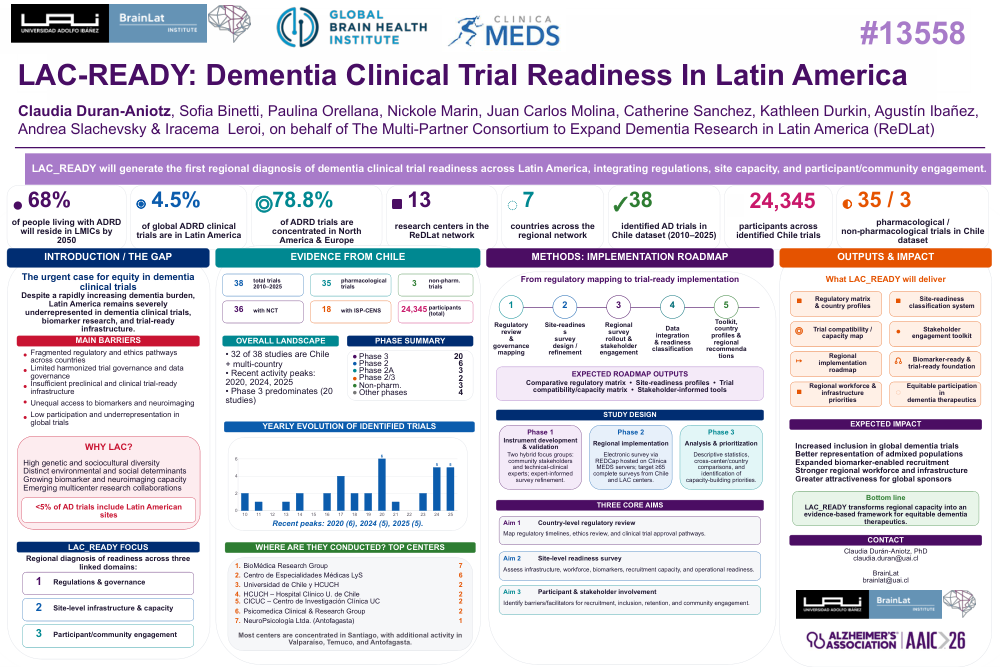
Background: Latin America (LA) faces a rapidly growing dementia burden and persistent structural inequities, yet remains underrepresented in ADRD clinical trial platforms. This underrepresentation is increasingly consequential as emerging pharmacological and non-pharmacological interventions will require diverse, trial-ready populations that better reflect the biological, environmental, and health-system heterogeneity of the region. Despite a strong base of potential participants, clinical expertise, active memory clinics, and internationally recognised research leadership, there is still no shared operational basis for comparing country-level trial-enabling conditions, assessing site-level readiness, or incorporating stakeholder perspectives into future trial activation. In the era of disease-modifying therapies, coordinated diagnostic pathways, operational readiness, and system-level preparedness are essential for equitable access to research and treatment.
Methods: Leveraging the ReDLat consortium, a LA network with well-characterized dementia cohorts and established regional research infrastructure, we will assess dementia clinical trial system readiness across LA through a three-phase approach. First, we will map country-level regulatory and governance conditions for dementia trials, including approval pathways, ethics review structures, timelines, multicountry study requirements, data and sample governance, and ADRD trial activity over the past decade. Second, we will implement a harmonized site survey across ReDLat-affiliated centres to assess site-level readiness across infrastructure, workforce capacity, biomarker and imaging access, clinical expertise, study management, recruitment and participant-access pathways, and coordination capacity. Third, we will conduct structured focus groups with clinicians, researchers, coordinators, patients, and care-partners to identify barriers and opportunities related to trust, participation, consent, communication, and emerging therapies, and to integrate these perspectives into future trial activation tools.
Results: This project will generate country-specific regulatory and governance profiles, a comparative bottleneck analysis, and a regional governance roadmap with practical templates for future multicountry trial activation. It will also produce site readiness profiles, a standardized readiness scoring system, and a trial-type matching matrix to identify sites prepared for different classes of dementia trials. In addition, the project will deliver a stakeholder-informed engagement and consent protocol, a practical readiness toolkit, and prioritized multicenter trial concept packages.
Conclusion: A system-level readiness perspective extends beyond isolated site willingness by identifying the regulatory, operational, and societal conditions required for equitable dementia trial implementation.
Comments
Email is required but is not shown publicly.
Loading comments...