4,068 posters, 219 videos, 101 topics, 69 sessions, 14,365 authors, 6,128 institutions
ePostersLive by SciGen Technologies S.A. All rights reserved.
Alzheimer's Association International Conference 2026
July 12-15, 2026 | London, United Kingdom, and Online

12991
Informing Inclusive Alzheimer’s Research In Down Syndrome: Input From Community-serving Organizations
Poster Presenter
Authors
Part of Topic
Dementia Care and Psychosocial Factors -> Dementia Care and Health Services Research -> Health and healthcare disparities
Background: Half of individuals with Down syndrome (DS) aged ≥65 develop Alzheimer’s dementia (AD). Despite advances in understanding AD in DS, populations such as Latinos and non-Latino Black individuals remain understudied in observational and experimental research. We aimed to identify barriers and facilitators to research participation among families of individuals with DS from understudied populations using perspectives from community-serving organizations.
Methods: We administered an online survey to a non-probabilistic sample of U.S. and Puerto Rican organizations between November 2025 and February 2026. Participants were eligible if they were ≥18 years old, worked for an organization serving individuals with DS including understudied populations, and could provide feedback in English or Spanish. Survey items included multiple-choice and open-ended questions assessing demographics, roles, organizational characteristics, and perspectives on research needs, barriers, facilitators, and desired outcomes. Analyses included descriptive statistics and qualitative description with two independent coders.
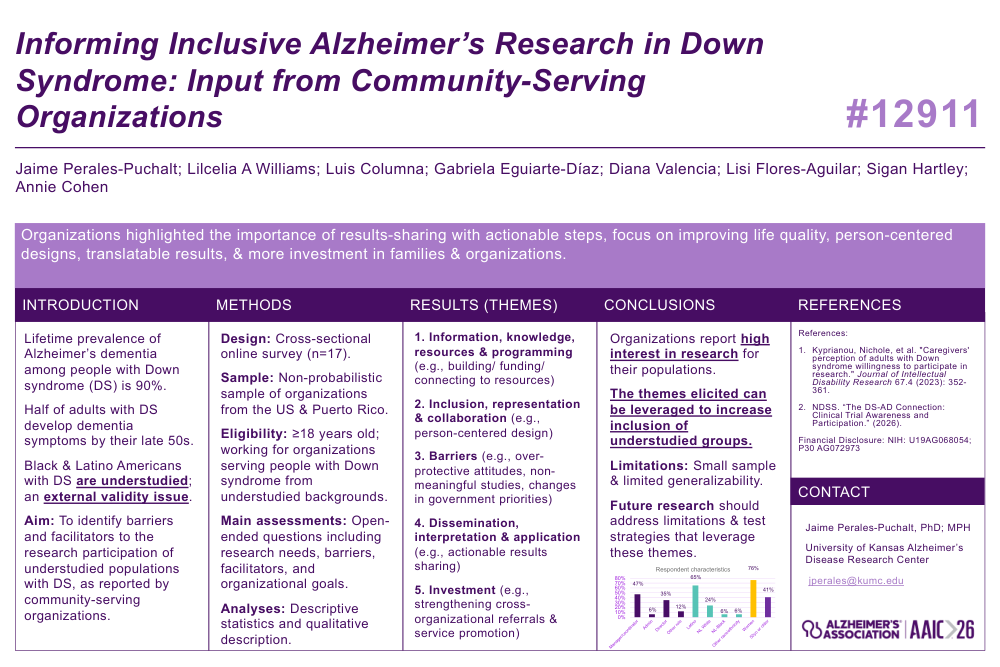
Results: Seventeen employees completed the survey; 76% were women, 65% Latino, 47% White, 12% Black, 6% Native American/Alaska Native, and 35% reported other race or preferred not to answer. The mean age was 45 (SD 12). Roles included managers (47%), directors (35%), administrators (6%), and other staff (12%). Over half (53%) worked in organizations involved in health or social services research, 36% regularly served rural families with DS, and most served Latino (94%), Black (65%), and other understudied groups (52%). Median numbers of individuals with DS aged ≥25 served per institution were 20 Latinos (IQR 3–183), 24 Black Americans (IQR 3–60), and 15 other understudied (IQR 3–40). Respondents expressed enthusiasm about research improving prevention, early detection, and life quality, and the need for representation. They expressed individual (e.g., belonging) and structural-level concerns challenges (e.g., shifting priorities). They emphasized rapid translation of findings into practice and sharing actionable results. Organizations identified key supports from research institutions, including referrals, inclusive study designs, services/materials, financial support, and scientific expertise.
Conclusions: Organizations serving individuals with DS from traditionally understudied and underserved populations are engaged and optimistic but face multilevel barriers. Strengthening partnerships through actionable dissemination, inclusive design, and tangible institutional support may enhance research relevance, participation, and impact.
Comments
Email is required but is not shown publicly.
Loading comments...