4,068 posters, 219 videos, 101 topics, 69 sessions, 14,365 authors, 6,128 institutions
ePostersLive by SciGen Technologies S.A. All rights reserved.
Alzheimer's Association International Conference 2026
July 12-15, 2026 | London, United Kingdom, and Online

13607
Incremental Effects Of Human Support In Technology-assisted Home Care For Cognitive Decline: Preliminary Report Of Four-group Study
Poster Presenter
Authors
Tso-Yen Mao, Chia-Ni Chou, Tsuei-E Lin, Shu-Feng Chang, Wen-Fu Wang, Pei-Ning Wang, Chien-Hsun Li
Affiliations
Department of Neurology, Kaohsiung Municipal Siaogang Hospital, and Kaohsiung Medical University Chung-Ho Memorial Hospital, Kaohsiung Medical University, Kaohsiung, Taiwan, National Chung Hsing University, Department of Leisure Services Management, Chaoyang University of Technology, Taichung, Taiwan, Science Creativity Invention Education Association, Min-Jhong Hospital, Pingtung County, Taiwan, Changhua Christian Hospital, Changhua County, Taiwan, Easeful Clinic, Taipei, Taiwan
Part of Topic
Dementia Care and Psychosocial Factors -> Dementia Care and Health Services Research -> Therapeutic strategies and interventions (e.g., pharmacological and non-pharmacological treatments)
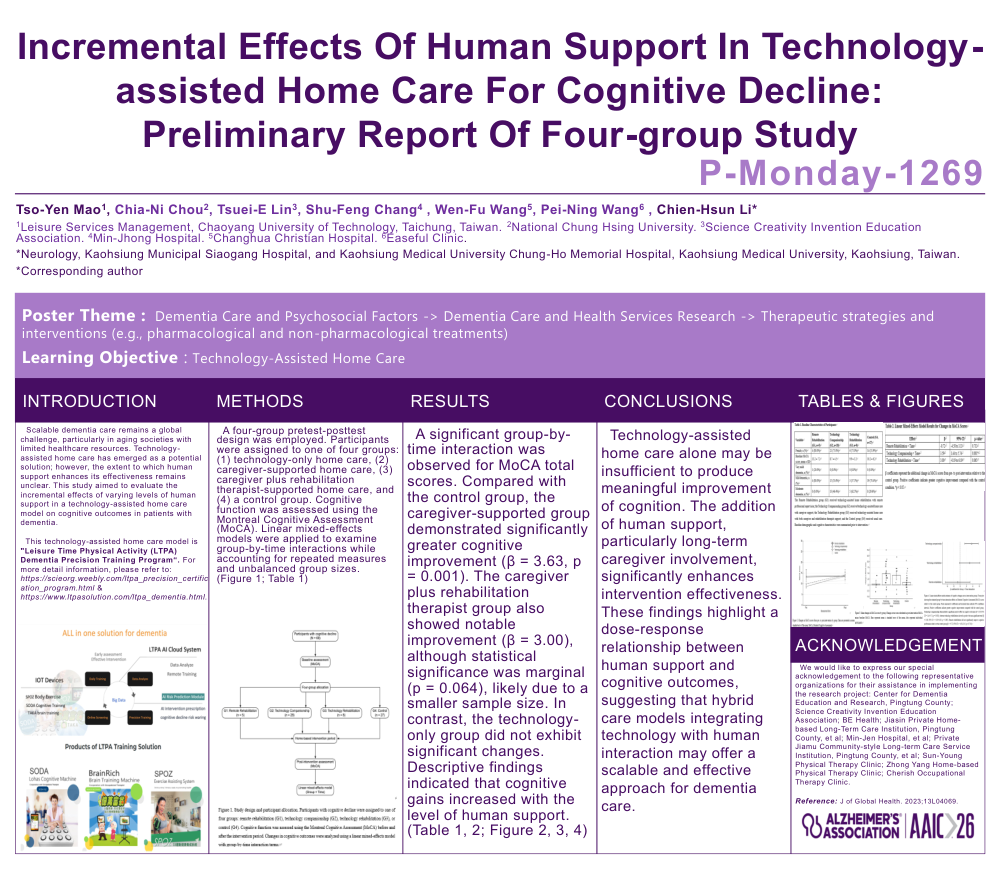
Background: Scalable dementia care remains a global challenge, particularly in aging societies with limited healthcare resources. Technology-assisted home care has emerged as a potential solution; however, the extent to which human support enhances its effectiveness remains unclear. This study aimed to evaluate the incremental effects of varying levels of human support in a technology-assisted home care model on cognitive outcomes in patients with dementia.
Methods: A four-group pretest-posttest design was employed. Participants were assigned to one of four groups: (1) technology-only home care, (2) caregiver-supported home care, (3) caregiver plus rehabilitation therapist-supported home care, and (4) a control group. Cognitive function was assessed using the Montreal Cognitive Assessment (MoCA). Linear mixed-effects models were applied to examine group-by-time interactions while accounting for repeated measures and unbalanced group sizes.
Results: A significant group-by-time interaction was observed for MoCA total scores. Compared with the control group, the caregiver-supported group demonstrated significantly greater cognitive improvement (β = 3.63, p = 0.001). The caregiver plus rehabilitation therapist group also showed notable improvement (β = 3.00), although statistical significance was marginal (p = 0.064), likely due to a smaller sample size. In contrast, the technology-only group did not exhibit significant changes. Descriptive findings indicated that cognitive gains increased with the level of human support.
Conclusion: Technology-assisted home care alone may be insufficient to produce meaningful improvement of cognition. The addition of human support, particularly long-term caregiver involvement, significantly enhances intervention effectiveness. These findings highlight a dose-response relationship between human support and cognitive outcomes, suggesting that hybrid care models integrating technology with human interaction may offer a scalable and effective approach for dementia care.
Comments
Email is required but is not shown publicly.
Loading comments...