4,068 posters, 219 videos, 101 topics, 69 sessions, 14,365 authors, 6,128 institutions
ePostersLive by SciGen Technologies S.A. All rights reserved.
Alzheimer's Association International Conference 2026
July 12-15, 2026 | London, United Kingdom, and Online

13441
Improving Access To Anti-amyloid Monoclonal Antibody Therapies For Mild Cognitive Impairment And Early Alzheimer’S Disease
Poster Presenter
Authors
Part of Topic
Dementia Care and Psychosocial Factors -> Dementia Care and Health Services Research -> Healthcare utilization and costs
Introduction:
• Administration of anti-amyloid monoclonal antibodies—lecanemab and donanemab—requires confirmation of amyloid pathology, biweekly to monthly infusion visits, and frequent MRI monitoring to assess for ARIA, including brain edema and microbleeds.
• Initiation of these medications requires prior authorization from the patient’s insurance provider or payer.
• Optimal social and economic determinants of health, along with access to dementia specialists, are critical for patients to access, navigate, and adhere to these treatments.
• We examined anti-amyloid drug use across regions, patient demographics, and prescriber specialty from 2023 to 2025.
Method:
• Analyzed Epic Cosmos data generated through collaboration with a community of Epic health systems, including >304 million patient records from >2,133 hospitals and 48.8K clinics.
• Reported differences in drug utilization by age, sex, race/ethnicity, insurance coverage, and region from 2023 to 2025.
• Described drug utilization by MCI vs ADRD, frailty, comorbidity, rural/urban residence, and prescriber type.
Result:
• Described drug utilization by MCI vs ADRD, frailty, comorbidity, rural/urban residence, and prescriber type
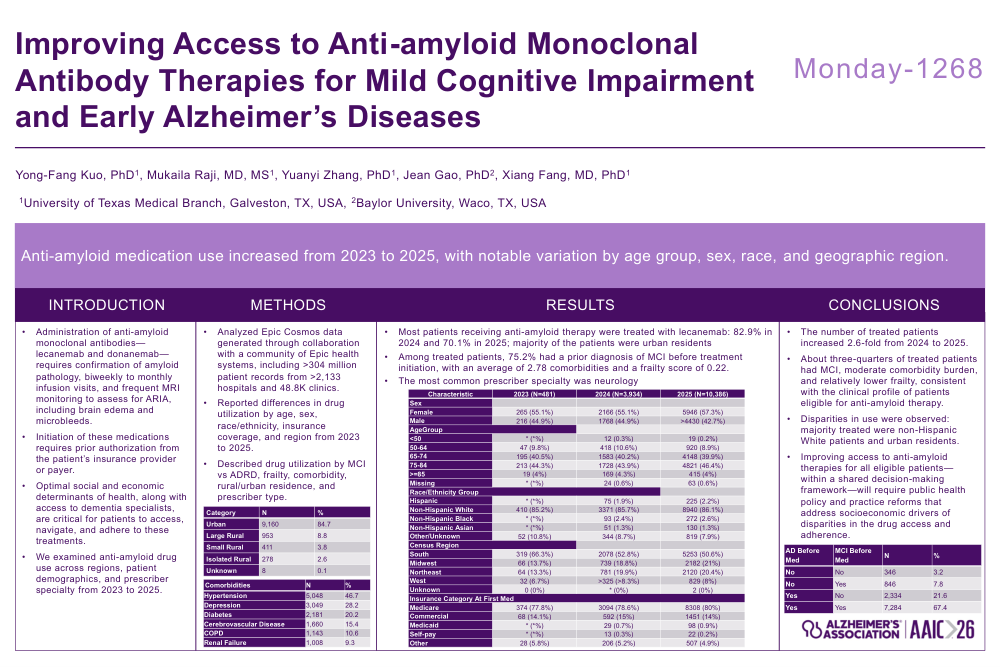
• Most patients receiving anti-amyloid therapy were treated with lecanemab: 82.9% in 2024 and 70.1% in 2025; majority of the patients were urban residents
• Among treated patients, 75.2% had a prior diagnosis of MCI before treatment initiation, with an average of 2.78 comorbidities and a frailty score of 0.22.
• The most common prescriber specialty was neurology
Conclusin:
• The number of treated patients increased 2.6-fold from 2024 to 2025.
• About three-quarters of treated patients had MCI, moderate comorbidity burden, and relatively lower frailty, consistent with the clinical profile of patients eligible for anti-amyloid therapy.
• Disparities in use were observed: majority treated were non-Hispanic White patients and urban residents
• Improving access to anti-amyloid therapies for all eligible patients—within a shared decision-making framework—will require public health policy and practice reforms that address socioeconomic drivers of disparities in the drug access and adherence.
Comments
Email is required but is not shown publicly.
Loading comments...