4,068 posters, 219 videos, 101 topics, 69 sessions, 14,365 authors, 6,128 institutions
ePostersLive by SciGen Technologies S.A. All rights reserved.
Alzheimer's Association International Conference 2026
July 12-15, 2026 | London, United Kingdom, and Online

13032
Human-validated Real-world Data: The Role Of Clinical Review In Ensuring Research-grade Quality Data In Alzheimer's
Poster Presenter
Authors
Affiliations
Part of Topic
Dementia Care and Psychosocial Factors -> Dementia Care and Health Services Research -> Healthcare information and technology (e.g., real-world data, health information exchange, AI in healthcare, patient registry)
Human-Validated Real-World Data: The Role of Expert Clinical Review in Ensuring Research-Grade Quality of Technology-Derived EHR Elements for Alzheimer's Disease Studies
Daniel Gautieri (SiteRx, Vice President of Strategy & Data Services); Daniel Barulli (SiteRx, Director of Clinical Data Science)
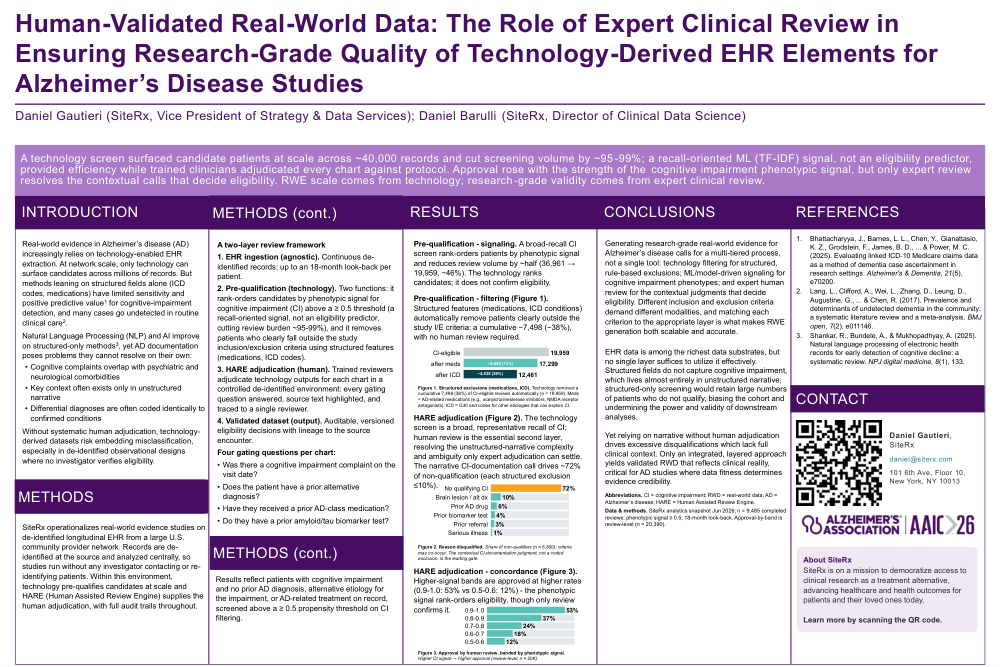
A technology screen surfaced candidate patients at scale across ~40,000 records and cut screening volume by ~95-99%; a recall-oriented ML (TF-IDF) signal, not an eligibility predictor, provided efficiency while trained clinicians adjudicated every chart against protocol. Approval rose with the strength of the cognitive impairment phenotypic signal, but only expert review resolves the contextual calls that decide eligibility. RWE scale comes from technology; research-grade validity comes from expert clinical review.
INTRODUCTION
Real-world evidence in Alzheimer's disease (AD) increasingly relies on technology-enabled EHR extraction. At network scale, only technology can surface candidates across millions of records. But methods leaning on structured fields alone (ICD codes, medications) have limited sensitivity and positive predictive value for cognitive-impairment detection, and many cases go undetected in routine clinical care. Natural Language Processing (NLP) and AI improve on structured-only methods, yet AD documentation poses problems they cannot resolve on their own: cognitive complaints overlap with psychiatric and neurological comorbidities; key context often exists only in unstructured narrative; differential diagnoses are often coded identically to confirmed conditions. Without systematic human adjudication, technology-derived datasets risk embedding misclassification, especially in de-identified observational designs where no investigator verifies eligibility.
METHODS
SiteRx operationalizes real-world evidence studies on de-identified longitudinal EHR from a large U.S. community provider network. Records are de-identified at the source and analyzed centrally, so studies run without any investigator contacting or re-identifying patients. Within this environment, technology pre-qualifies candidates at scale and HARE (Human Assisted Review Engine) supplies the human adjudication, with full audit trails throughout.
A two-layer review framework: (1) EHR ingestion (agnostic) - continuous de-identified records; up to an 18-month look-back per patient. (2) Pre-qualification (technology) - two functions: it rank-orders candidates by phenotypic signal for cognitive impairment (CI) above a >=0.5 threshold (a recall-oriented signal, not an eligibility predictor, cutting review burden ~95-99%), and it removes patients who clearly fall outside the study inclusion/exclusion criteria using structured features (medications, ICD codes). (3) HARE adjudication (human) - trained reviewers adjudicate technology outputs for each chart in a controlled de-identified environment: every gating question answered, source text highlighted, and traced to a single reviewer. (4) Validated dataset (output) - auditable, versioned eligibility decisions with lineage to the source encounter.
Four gating questions per chart: Was there a cognitive impairment complaint on the visit date? Does the patient have a prior alternative diagnosis? Have they received a prior AD-class medication? Do they have a prior amyloid/tau biomarker test?
Results reflect patients with cognitive impairment and no prior AD diagnosis, alternative etiology for the impairment, or AD-related treatment on record, screened above a >=0.5 propensity threshold on CI filtering.
RESULTS
Pre-qualification - signaling: A broad-recall CI screen rank-orders patients by phenotypic signal and reduces review volume by ~half (36,961 to 19,959, -46%). The technology ranks candidates; it does not confirm eligibility.
Pre-qualification - filtering (Figure 1): Structured features (medications, ICD conditions) automatically remove patients clearly outside the study I/E criteria: a cumulative -7,498 (-38%), with no human review required. CI-eligible 19,959; after meds -2,660 (13%) = 17,299; after ICD -4,838 (28%) = 12,461.
HARE adjudication (Figure 2): The technology screen is a broad, representative recall of CI; human review is the essential second layer, resolving the unstructured-narrative complexity and ambiguity only expert adjudication can settle. The narrative CI-documentation call drives ~72% of non-qualification (each structured exclusion <=10%). Reason disqualified (share of non-qualifiers, n ~ 6,800; criteria may co-occur): no qualifying CI 72%, brain lesion / alt dx 10%, prior AD drug 6%, prior biomarker test 4%, prior referral 3%, serious illness 1%.
HARE adjudication - concordance (Figure 3): Higher-signal bands are approved at higher rates (0.9-1.0: 53% vs 0.5-0.6: 12%) - the phenotypic signal rank-orders eligibility, though only review confirms it. Approval by band: 0.9-1.0 = 53%; 0.8-0.9 = 37%; 0.7-0.8 = 24%; 0.6-0.7 = 18%; 0.5-0.6 = 12%.
CONCLUSIONS
Generating research-grade real-world evidence for Alzheimer's disease calls for a multi-tiered process, not a single tool: technology filtering for structured, rule-based exclusions; ML/model-driven signaling for cognitive impairment phenotypes; and expert human review for the contextual judgments that decide eligibility. Different inclusion and exclusion criteria demand different modalities, and matching each criterion to the appropriate layer is what makes RWE generation both scalable and accurate.
EHR data is among the richest data substrates, but no single layer suffices to utilize it effectively. Structured fields do not capture cognitive impairment, which lives almost entirely in unstructured narrative; structured-only screening would retain large numbers of patients who do not qualify, biasing the cohort and undermining the power and validity of downstream analyses. Yet relying on narrative without human adjudication drives excessive disqualifications which lack full clinical context. Only an integrated, layered approach yields validated RWD that reflects clinical reality, critical for AD studies where data fitness determines evidence credibility.
REFERENCES
- Bhattacharyya J, Barnes LL, Chen Y, Gianattasio KZ, Grodstein F, James BD, ... & Power MC. (2025). Evaluating linked ICD-10 Medicare claims data as a method of dementia case ascertainment in research settings. Alzheimer's & Dementia, 21(5), e70200.
- Lang L, Clifford A, Wei L, Zhang D, Leung D, Augustine G, ... & Chen R. (2017). Prevalence and determinants of undetected dementia in the community: a systematic literature review and a meta-analysis. BMJ Open, 7(2), e011146.
- Shankar R, Bundele A, & Mukhopadhyay A. (2025). Natural language processing of electronic health records for early detection of cognitive decline: a systematic review. NPJ Digital Medicine, 8(1), 133.
Abbreviations: CI = cognitive impairment; RWD = real-world data; AD = Alzheimer's disease; HARE = Human Assisted Review Engine.
Data & methods: SiteRx analytics snapshot Jun 2026; n = 9,485 completed reviews; phenotypic signal >=0.5; 18-month look-back. Approval-by-band is review-level (n = 20,390).
CONTACT
Daniel Gautieri, SiteRx. daniel@siterx.com. 101 6th Ave, Floor 10, New York, NY 10013.
Comments
Email is required but is not shown publicly.
Loading comments...