4,068 posters, 219 videos, 101 topics, 69 sessions, 14,365 authors, 6,128 institutions
ePostersLive by SciGen Technologies S.A. All rights reserved.
Alzheimer's Association International Conference 2026
July 12-15, 2026 | London, United Kingdom, and Online

13548
Health App Recommendation Tool, Hart: Preliminary Evidence From An Ongoing N-of-1 Trial With Young And Middle-aged Dementia Caregivers
Poster Presenter
Authors
Jerry Li, Ian O'Leary, Sungwoo (Caleb) Moon, Claire Magness, Yong Choi, Hu Haomin, Julie Faieta
Affiliations
Part of Topic
Dementia Care and Psychosocial Factors -> Dementia Care and Health Services Research -> Digital and mobile health (e.g., telemedicine, virtual care, remote monitoring)
Title: Health App Recommendation Tool, HART: Preliminary Evidence From an Ongoing N-of-1 Trial With Young and Middle-Aged Dementia Caregivers
Authors: Jerry Li, Ian O'Leary, Sungwoo (Caleb) Moon MS, Claire Magness, Yong Choi PhD MPH, Hu Haomin PhD, Julie Faieta PhD MOT OTR/L
Affiliations: Department of Rehabilitation Science and Technology, University of Pittsburgh, Pittsburgh, PA; Department of Health Information Management, University of Pittsburgh, Pittsburgh, PA
Background
Two-thirds of U.S. dementia caregivers are young or middle-aged. Caregivers face challenges of managing careers and families while devoting up to 145 hours per month to caregiving. This balancing act, the "Caregiver Penalty", makes dementia caregivers more likely to experience hypertension, depression, and chronic pain. With caregivers typically seeing a specialist 1-2 times per year, most day-to-day questions, stressors, and health needs receive no support. Health apps offer a scalable, accessible solution, providing real-time support, symptom tracking, mindfulness tools, care coordination, and more. Critical barriers remain: caregivers face a confusing landscape of hundreds of thousands of apps with no reliable way to identify which are trustworthy or relevant.
Methods
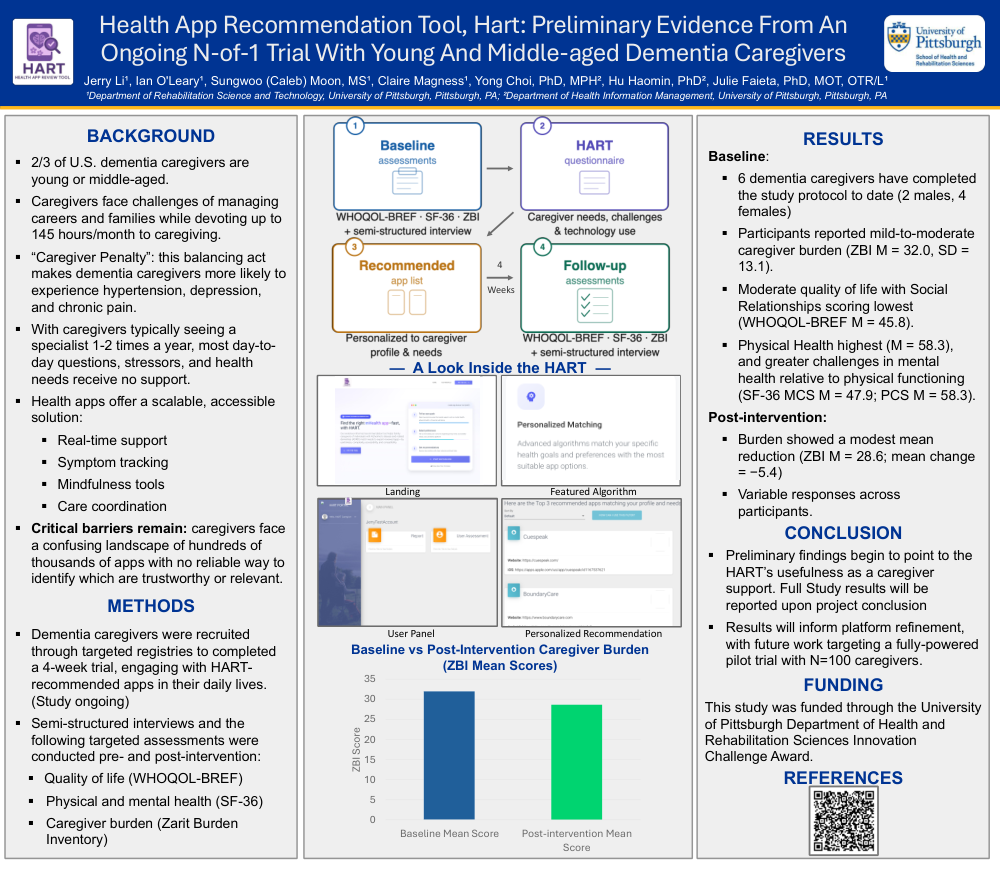
Dementia caregivers were recruited through targeted registries to complete a 4-week trial, engaging with HART-recommended apps in their daily lives (study ongoing). Semi-structured interviews and targeted assessments were conducted pre- and post-intervention, including quality of life (WHOQOL-BREF), physical and mental health (SF-36), and caregiver burden (Zarit Burden Inventory).
Results
Baseline: Six dementia caregivers have completed the study protocol to date (2 males, 4 females). Participants reported mild-to-moderate caregiver burden (ZBI M = 32.0, SD = 13.1). Moderate quality of life was observed, with Social Relationships scoring lowest (WHOQOL-BREF M = 45.8). Physical Health scored highest (M = 58.3), with greater challenges in mental health relative to physical functioning (SF-36 MCS M = 47.9; PCS M = 58.3).
Post-intervention: Burden showed a modest mean reduction (ZBI M = 28.6; mean change = −5.4), with variable responses across participants.
Conclusion
Preliminary findings point to HART's usefulness as a caregiver support tool. Full study results will be reported upon project conclusion. Results will inform platform refinement, with future work targeting a fully-powered pilot trial with N=100 caregivers.
Funding
University of Pittsburgh Department of Health and Rehabilitation Sciences Innovation Challenge Award.
Comments
Email is required but is not shown publicly.
Loading comments...