Loading...

4,068 posters, 219 videos, 101 topics, 69 sessions, 14,365 authors, 6,128 institutions

ePostersLive by SciGen Technologies S.A. All rights reserved.

Alzheimer's Association International Conference 2026

July 12-15, 2026 | London, United Kingdom, and Online

Alzheimer's Association International Conference 2026 banner

12864

From Willingness To Participation: Decision-making In Alzheimer’S Research Among Hispanic/latino Older Adults
Part of Topic

Dementia Care and Psychosocial Factors -> Psychosocial and Behavioral Factors -> Underrepresented populations and cross-cultural studies (including cultural and linguistic adaptations)

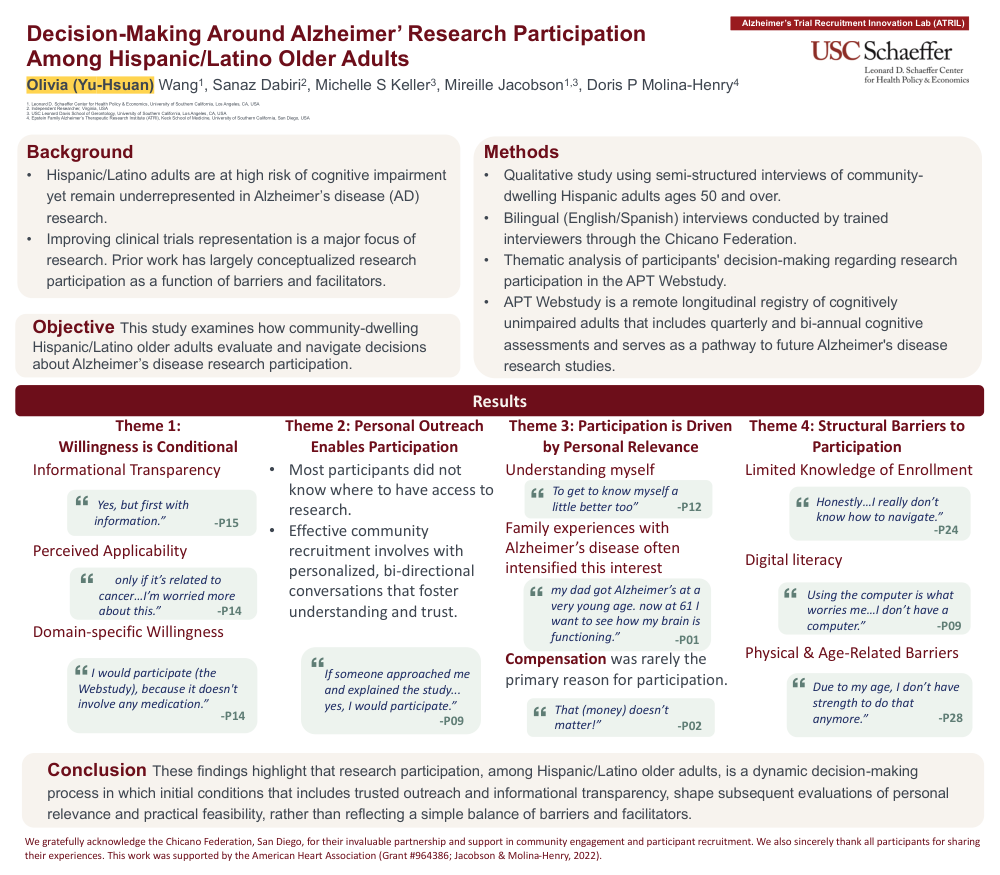
Background: Hispanic/Latino adults are athigh risk of cognitive impairment yet remain underrepresented in Alzheimer’s disease (AD) research. Improving clinical trials representation is a major focus of research. Prior work has largely conceptualized research participation as a function of barriers and facilitators. This study examines how community-dwelling Hispanic/Latino older adults evaluate and navigate decisions about Alzheimer’s disease research participation.
 
Methods: Qualitative study using semi-structured interviews of community-dwelling Hispanic adults ages 50 and over. Bilingual (English/Spanish) interviews conducted by trained interviewers through the Chicano Federation. hematic analysis of participants' decision-making regarding research participation in the APT Webstudy, a remote longitudinal registry of cognitively unimpaired adults that includes quarterly and bi-annual cognitive assessments and serves as a pathway to future Alzheimer's disease research studies.
 
Results: Most interviewees were Spanish speakers and thus completed interviews in Spanish. Many reported less than a high school education. Four themes were identified: (1) Conditional willingness, in which participants framed participation as contingent on preconditions such as evaluation of informational transparency, personal relevance and safety; (2) Community recruitment is effective when it involves personalized, bi-directional conversations that foster understanding and trust; (3) Personal relevance to health as a central motivation, with compensation as secondary consideration, and (4) Structural barriers, including limited knowledge of how to enroll, digital literacy challenges, and physical limitations.
 
Conclusions: These findings highlight that research participation, among Hispanic/Latino older adults, is a dynamic decision-making process in which initial conditions that includes trusted outreach and informational transparency, shape subsequent evaluations of personal relevance and practical feasibility, rather than reflecting a simple balance of barriers and facilitators.
 

Comments

Email is required but is not shown publicly.

Loading comments...

aaic2026 banner
Copyright © 2015-2026, ePostersLive® SciGen is a registered trademark of SciGen Technologies S.A. Patent pending.

This website and third-party tools we use rely on cookies for the best user experience. By selecting "I agree", you agree to cookie usage as described in our Privacy Policy.