4,068 posters, 219 videos, 101 topics, 69 sessions, 14,365 authors, 6,128 institutions
ePostersLive by SciGen Technologies S.A. All rights reserved.
Alzheimer's Association International Conference 2026
July 12-15, 2026 | London, United Kingdom, and Online

12940
Diverse Older Adults’ Perspectives On Why They Would Undergo Amyloid PET And Participate In A Preclinical AD Trial
Poster Presenter
Authors
Melany Medina, Eunji Russ, Megan Witbracht, Kristin Harkins, Jason Karlawish, Joshua Grill, Crystal Glover
Affiliations
Institute for Memory Impairments and Neurological Disorders, University of California, Irvine , Irvine, CA, USA, University of Pennsylvania Perelman School of Medicine , Philadelphia, PA, USA
Part of Topic
Dementia Care and Psychosocial Factors -> Dementia Care and Health Services Research -> Therapeutic strategies and interventions (e.g., pharmacological and non-pharmacological treatments)
Background: Preclinical Alzheimer's disease (AD) trials require biomarker testing, such as amyloid PET, to determine participant eligibility. Little is known about how older adults decide whether to undergo biomarker testing and receive their results. Among a racially and ethnically diverse sample of cognitively unimpaired older adults, we examined motivations for undergoing amyloid PET, both generally and within the context of a preclinical AD trial.
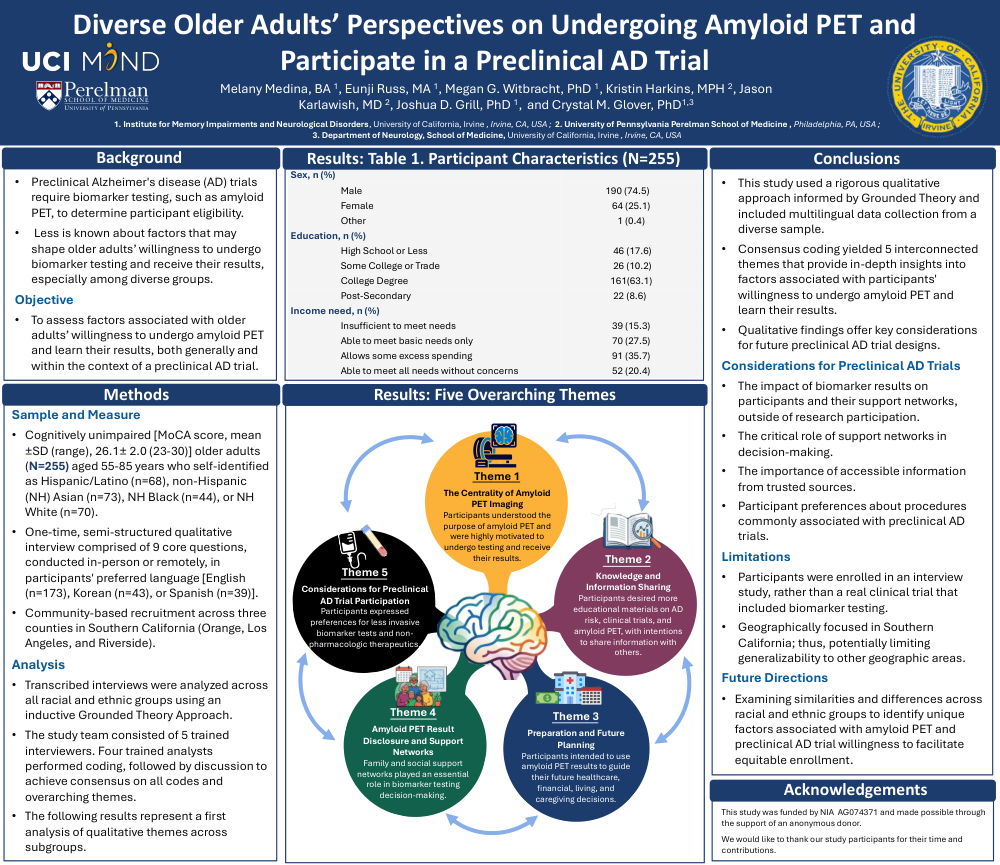
Methods: Participants aged 55-85 (N=255; mean age 68.7 years; 75% female) who self-identified as Hispanic/Latino (n=68), non-Hispanic (NH) Asian (n=73), NH Black (n=44), or NH White (n=70) completed a one-time, semi-structured interview comprised of 9 core questions, conducted in-person or remotely in participants' preferred language (English, Korean, or Spanish). Transcribed interviews were analyzed using an inductive Grounded Theory Approach. The study team consisted of 5 trained interviewers and 4 trained analysts who performed coding, followed by discussion and consensus on all codes and the development of overarching themes.
Results: Five interconnected themes emerged across participants. Theme 1: Participants understood the purpose of amyloid PET and were highly motivated to undergo testing and receive their results. Theme 2: Participants desired more educational materials on AD risk, clinical trials, and amyloid PET, with intentions to share information with others. Theme 3: Participants planned to use PET results to guide their future healthcare, financial, living, and caregiving decisions. Theme 4: Family and social support networks played an essential role in biomarker testing decision-making. Theme 5: Participants expressed preferences for less invasive biomarker tests and non-pharmacologic therapeutics when considering preclinical AD trial participation.
Conclusion: Diverse older adults’ perspectives on willingness to undergo amyloid PET and learn their results in the context of preclinical AD trials included the broad personal impact of biomarker results other than research participation, the importance of accessible information from trusted sources, the central role of support networks in decision making, and participant concerns about procedures commonly associated with preclinical AD trials.
Comments
Email is required but is not shown publicly.
Loading comments...