4,068 posters, 219 videos, 101 topics, 69 sessions, 14,365 authors, 6,128 institutions
ePostersLive by SciGen Technologies S.A. All rights reserved.
Alzheimer's Association International Conference 2026
July 12-15, 2026 | London, United Kingdom, and Online

13770
Co-designing A Brain Health Communication And Care-seeking Toolkit With Older Vietnamese American Communities
Poster Presenter
Authors
Kris Pui Kwan Ma, Azelea Sayavong, Rebecca Chhoy, James Sherrell, Khanh Luong, Kim Lundgreen, Diem Nguyen, Asmeret Tesfalem
Affiliations
Department of Family Medicine, University of Washington, Community House Calls, Interpreter Services, Harborview Medical Center, Department of Health Systems and Population Health, University of Washington, EthnoMed, Interpreter Services, Harborview Medical Center, Department of Global Health, University of Washington
Part of Topic
Dementia Care and Psychosocial Factors -> Psychosocial and Behavioral Factors -> Underrepresented populations and cross-cultural studies (including cultural and linguistic adaptations)
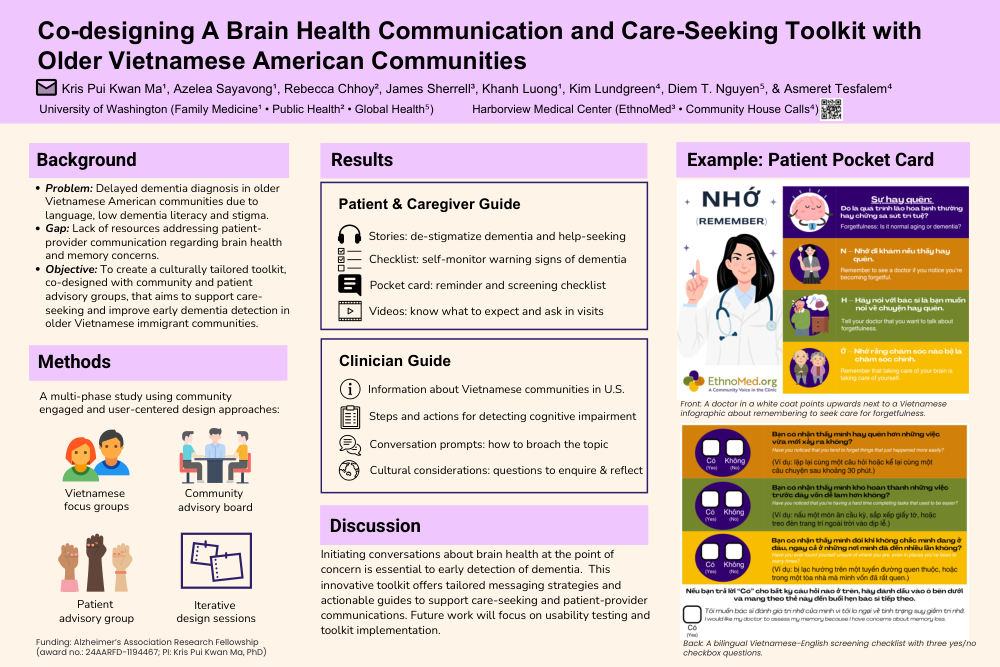
Background: Older Vietnamese Americans experience delayed/missed diagnoses of dementia due to language barriers, low dementia literacy, and stigma. Existing resources raiseawareness about dementia, but few address how to communicate memory concerns withhealthcare providers. This study presents a culturally and linguistically tailored brain health communication and care-seeking toolkit that is co-designed bya community advisory board (CAB) and a patient advisory group (PAG). The toolkit aims to provide education and practical strategies to support care-seeking behaviors and facilitatepatient-provider discussions about memory concerns during clinical visits, with the goal of improving early detection of dementia among older Vietnamese-speaking adults.
Methods: The CAB included five members recruited from the community and clinics: a Vietnamese caseworker-cultural mediator, a community leader, a bicultural family physician, a nurse, and a health educator. CAB members held seven virtual meetings from December 2025 – April 2026 to develop toolkit content and messaging strategies, using their expertise and our focus group findings with Vietnamese older adults. A PAG of five Vietnamese patients with lived experience of mild cognitive impairment/early dementia were recruited from a senior association. They held two meetings in Vietnamese with an interpreter to provide ideas and feedback on the toolkit.
Results: Two resource guides were developed as part of the toolkit. Abilingual patient/caregiver-facing guide includesnarrative vignettes illustrating experiences of forgetfulness and care-seeking to highlight the benefits of early detection;a checklist to help individuals and families determine when to seek care;a pocket card featuring warning signs and prompts to facilitate patient-provider discussions; a diagram outlining the cognitive evaluation process; and resources to support caregiver planning and preparation. A provider-facing guide includes practical guidance on detecting cognitive impairment, culturally appropriate screening tools, conversation scripts to support shared decision-making around brain health, and key cultural considerations for working with Vietnamese communities.
Conclusions:This innovative toolkit addresses a critical gap contributing to delayed dementia diagnosis and underutilization of formal services in Vietnamese communities by offering tailored messaging strategies and actionable tools to support care-seeking and patient–provider communication. Future work will focus on usability testing and toolkit implementation.
Comments
Email is required but is not shown publicly.
Loading comments...