Loading...

4,068 posters, 219 videos, 101 topics, 69 sessions, 14,365 authors, 6,128 institutions

ePostersLive by SciGen Technologies S.A. All rights reserved.

Alzheimer's Association International Conference 2026

July 12-15, 2026 | London, United Kingdom, and Online

Alzheimer's Association International Conference 2026 banner

13155

Black American Perspectives On Cultural Safety In Research: Physical, Emotional, And Interpersonal Safety
Part of Topic

Dementia Care and Psychosocial Factors -> Psychosocial and Behavioral Factors -> Underrepresented populations and cross-cultural studies (including cultural and linguistic adaptations)

Background: 

•Although Black Americans  face twice the rate of Alzheimer’s Disease (AD) compared to non-Hispanic Whites, they make up less than 5% of AD clinical trial participants
•Black Americans report mistrust of academic and research institutions as a significant barrier, citing fear related to research, inadequate information, and logistical concerns
•Cultural safety requires individuals and organizations to examine how privilege, bias, and the dominant culture shape their practices
•Despite its potential, cultural safety remains underrecognized in research settings and has not been adapted to the experience of Black communities
Māori Indigenous concept, Actively calls out power imbalances, Defined by the person receiving the service, Highlights the ongoing impact of racism, slavery, and colonization, Requires self-reflection
 
Objectives: 
•Explore how Black-identifying individuals define cultural safety, and how they understand it and practice it
•Cultural safety originates from Indigenous frameworks; we examined how it is interpreted and how it can be applied within research settings for Black participants
 
Sample: 

Participant pool was embedded within the larger Brain CHEC-AC study (U01NS141777). Purposive sampling was used to recruit community dwelling individuals from the Pittsburgh, Pennsylvania area

Methods: 

•Qualitative descriptive study
•Questions asked:

1. When you hear the word cultural safety, what comes to mind?

2. What helps you feel safe or seen in an interaction with a researcher or clinician?

3. Was there ever a time you felt unsafe or uncomfortable in an interaction with a researcher or clinician?

•Line-by-line inductive coding
•Recruitment continued until thematic saturation was reached
 
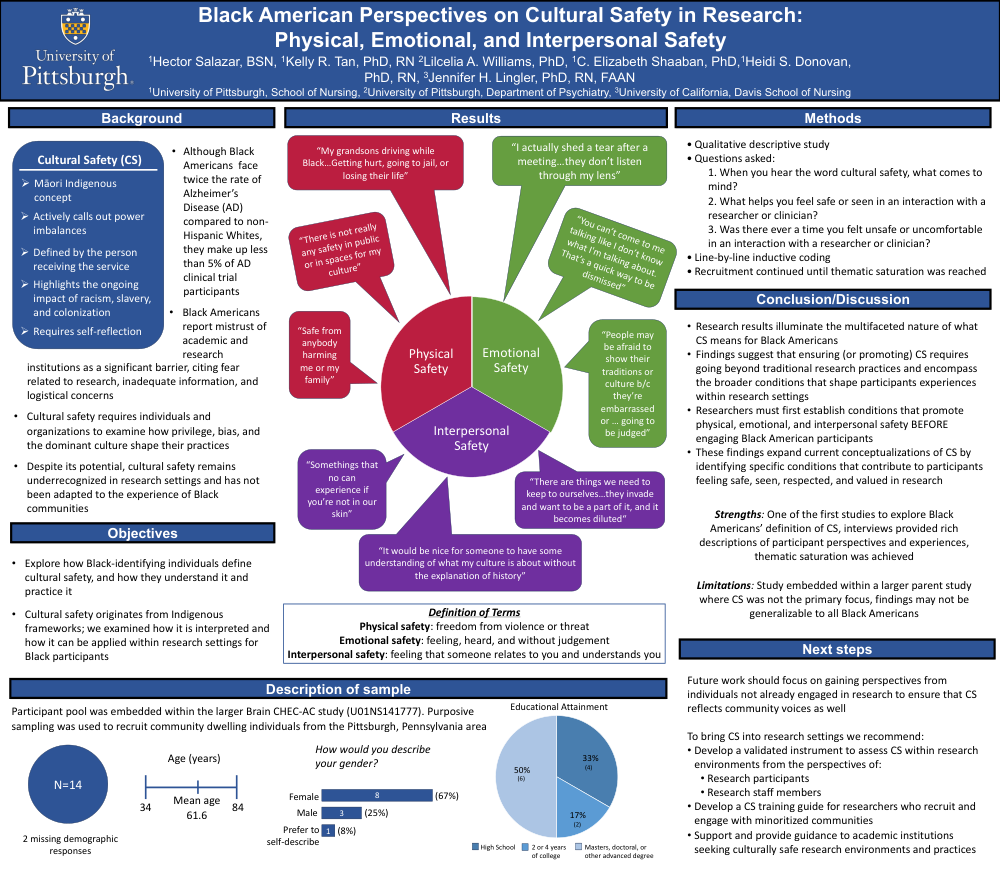
Results: 

Definition of Terms

Physical safety: freedom from violence or threat- 

“There is not really any safety in public or in spaces for my culture”

Emotional safety: feeling, heard, and without judgement-

“You can’t come to me talking like I don’t know what I'm talking about. That’s a quick way to be dismissed”

Interpersonal safety: feeling that someone relates to you and understands you-

“It would be nice for someone to have some understanding of what my culture is about without the explanation of history”

Conclusion: 

•Research results illuminate the multifaceted nature of what CS means for Black Americans
•Findings suggest that ensuring (or promoting) CS requires going beyond traditional research practices and encompass the broader conditions that shape participants experiences within research settings
•Researchers must first establish conditions that promote physical, emotional, and interpersonal safety BEFORE engaging Black American participants
•These findings expand current conceptualizations of CS by identifying specific conditions that contribute to participants feeling safe, seen, respected, and valued in research

Strengths: One of the first studies to explore Black Americans’ definition of CS, interviews provided rich descriptions of participant perspectives and experiences, thematic saturation was achieved

Limitations: Study embedded within a larger parent study where CS was not the primary focus, findings may not be generalizable to all Black Americans

Next steps: 

Future work should focus on gaining perspectives from individuals not already engaged in research to ensure that CS reflects community voices as well

To bring CS into research settings we recommend:

•Develop a validated instrument to assess CS within research environments from the perspectives of:
•Research participants
•Research staff members 
•Develop a CS training guide for researchers who recruit and engage with minoritized communities 
•Support and provide guidance to academic institutions seeking culturally safe research environments and practices


Comments

Email is required but is not shown publicly.

Loading comments...

aaic2026 banner
Copyright © 2015-2026, ePostersLive® SciGen is a registered trademark of SciGen Technologies S.A. Patent pending.

This website and third-party tools we use rely on cookies for the best user experience. By selecting "I agree", you agree to cookie usage as described in our Privacy Policy.