4,068 posters, 219 videos, 101 topics, 69 sessions, 14,365 authors, 6,128 institutions
ePostersLive by SciGen Technologies S.A. All rights reserved.
Alzheimer's Association International Conference 2026
July 12-15, 2026 | London, United Kingdom, and Online

13491
Biomechanical Evaluation Of Transcranial Vibroacoustic Stimulation (tVAS) For Enhancing Cerebrospinal Fluid Circulation
Poster Presenter
Part of Topic
Dementia Care and Psychosocial Factors -> Dementia Care and Health Services Research -> Therapeutic strategies and interventions (e.g., pharmacological and non-pharmacological treatments)
Background:
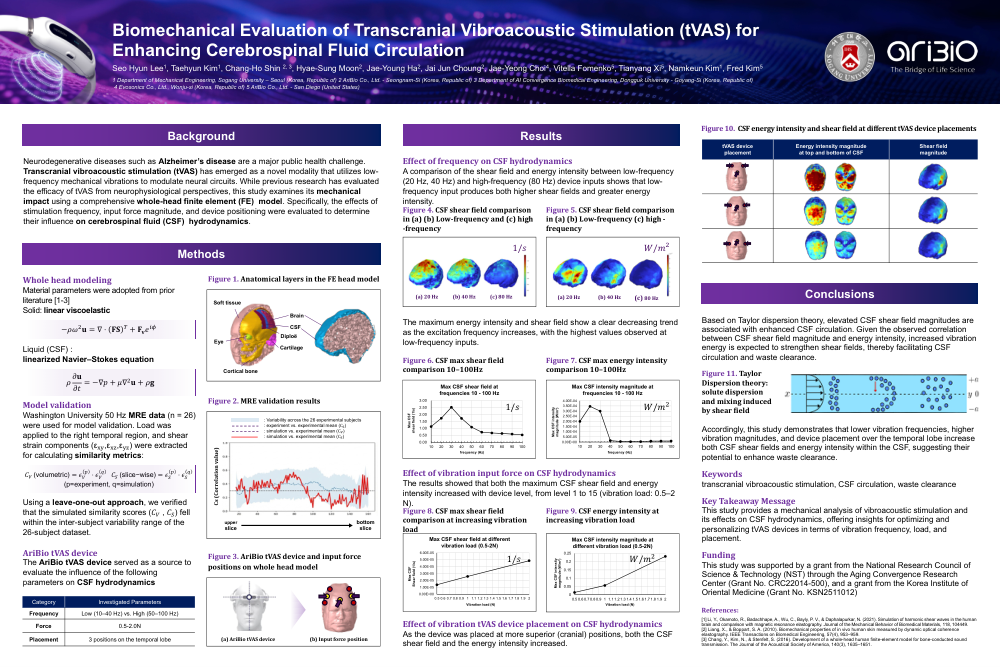
Neurodegenerative diseases such as Alzheimer’s disease are a major public health challenge. Transcranial vibroacoustic stimulation (tVAS) has emerged as a novel modality that utilizes low-frequency mechanical vibrations to modulate neural circuits. While previous research has evaluated the efficacy of tVAS from neurophysiological perspectives, this study examines its mechanical impact using a comprehensive whole-head finite element (FE) model. Specifically, the effects of stimulation frequency, input force magnitude, and device positioning were evaluated to determine their influence on cerebrospinal fluid (CSF) hydrodynamics.
Methods:
Whole head modeling
Material parameters were adopted from prior literature [1-3]
Solid: linear viscoelastic
-ρω2 u=∇⋅(FS)T+Fv eiϕ
Liquid (CSF) : linearized Navier–Stokes equation
ρ ∂u/∂t=-∇p+μ∇2 u+ρg
Model validation
Washington University 50 Hz MRE data (n = 26) were used for model validation. Load was applied to the right temporal region, and shear strain components (εxy,εxz,εyz) were extracted for calculating similarity metrics:
CV(volumetric)=ϵV(p) ⋅ ϵV(q) CS (slice-wise)=ϵS(p)⋅ ϵS(q)
(p=experiment, q=simulation)
Using a leave-one-out approach, we verified that the simulated similarity scores (CV , CS) fell within the inter-subject variability range of the 26-subject dataset.
AriBio tVAS device
The AriBio tVAS device served as a source to evaluate the influence of the following parameters on CSF hydrodynamics
Results:
Effect of frequency on CSF hydrodynamics:
A comparison of the shear field and energy intensity between low-frequency (20 Hz, 40 Hz) and high-frequency (80 Hz) device inputs shows that low- frequency input produces both higher shear fields and greater energy intensity.
The maximum energy intensity and shear field show a clear decreasing trend as the excitation frequency increases, with the highest values observed at low-frequency inputs.
Effect of vibration input force on CSF hydrodynamics
The results showed that both the maximum CSF shear field and energy intensity increased with device level, from level 1 to 15 (vibration load: 0.5–2 N).
Effect of vibration tVAS device placement on CSF hydrodynamics
As the device was placed at more superior (cranial) positions, both the CSF shear field and the energy intensity increased.
Conclusions:
Based on Taylor dispersion theory, elevated CSF shear field magnitudes are associated with enhanced CSF circulation. Given the observed correlation between CSF shear field magnitude and energy intensity, increased vibration energy is expected to strengthen shear fields, thereby facilitating CSF circulation and waste clearance.
Accordingly, this study demonstrates that lower vibration frequencies, higher vibration magnitudes, and device placement over the temporal lobe increase both CSF shear fields and energy intensity within the CSF, suggesting their potential to enhance waste clearance.
Keywords
transcranial vibroacoustic stimulation, CSF circulation, waste clearance
Key Takeaway Message
This study provides a mechanical analysis of vibroacoustic stimulation and its effects on CSF hydrodynamics, offering insights for optimizing and personalizing tVAS devices in terms of vibration frequency, load, and placement.
Funding
This study was supported by a grant from the National Research Council of Science & Technology (NST) through the Aging Convergence Research Center (Grant No. CRC22014-500), and a grant from the Korea Institute of Oriental Medicine (Grant No. KSN2511012)
Comments
Email is required but is not shown publicly.
Loading comments...