4,068 posters, 219 videos, 101 topics, 69 sessions, 14,365 authors, 6,128 institutions
ePostersLive by SciGen Technologies S.A. All rights reserved.
Alzheimer's Association International Conference 2026
July 12-15, 2026 | London, United Kingdom, and Online

13023
Beyond Accuracy: Real-World Value And Feasibility Of Two-stage Alzheimer's Screening
Poster Presenter
Authors
Carla VandeWeerd, PhD, David Wilson, PhD, James E. Galvin, MD, MPH, Mitchell Roberts, PhD, Lindsey Mette, MS, MPH, CGC, Catherine Tallmadge, Erica Sappington, PhD, Zachary Fernandes, MBA, Heather M. Harris, Roma Tremblay, APRN, DNP, Jorge Marques Signes, PhD, Paul W. Estes, Kylee Corneliussen, Michael Jaffee, MD
Affiliations
UF Precision Health Research Center, University of Florida, The Villages®, FL, USA, Cognivue®, Victor, NY, USA, Quanterix®, Billerica, MA, USA, Department of Neurology, University of Florida, Gainesville, FL, USA
Part of Topic
Dementia Care and Psychosocial Factors -> Dementia Care and Health Services Research -> Prevention and risk reduction strategies
Beyond Accuracy: Real-World Value And Feasibility Of Two-stage Alzheimer's Screening
Background: Early detection of Alzheimer’s disease (AD) is limited by access to scalable, , and cost-efficient screening approaches. While two-stage models
combining cognitive assessment and blood-based biomarkers have demonstrated strong retrospective performance, prospective evidence on participant centered value and real-world feasibility is limited. This study evaluates both screening outcomes and perceived value of a community-based, two-step AD
risk assessment model.
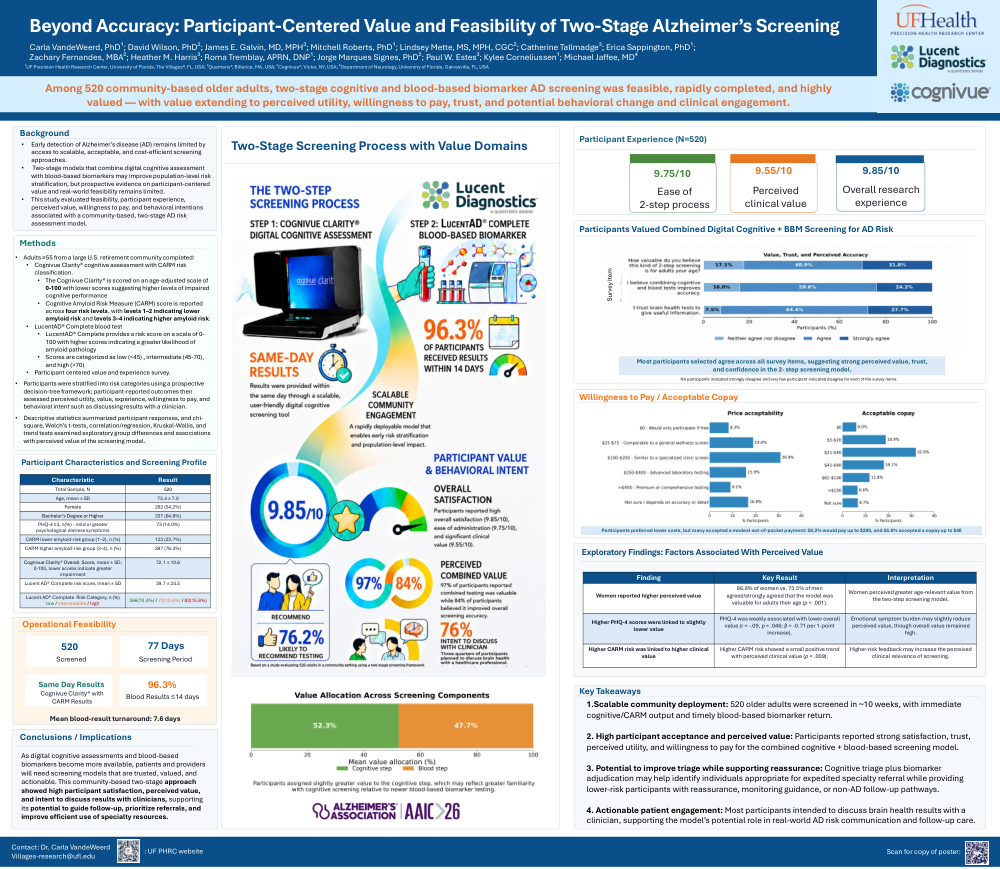
Methods: A total of 519 adults (≥55 years) from a large U.S. retirement community completed a self-report health survey, the Cognivue Clarity® digital
cognitive assessment with its integrated Cognivue Amyloid Risk Measure (CARM), and the LucentAD® Complete blood test. A prospective decision-tree
framework stratified participants into clinically meaningful risk categories. Participant experience, perceived value, willingness-to-pay, and behavioral intent
were assessed alongside operational metrics.
Results: 519 participants were screened over ~10 weeks. Cognitive assessment results, including CARM, were available immediately. Blood-based results
were returned within 10 days for 81.8% (mean 7.6 days), within 14 days for 95.9%.Participants (mean age 73.4±7.0; 54.3% female) reported high satisfaction
with the two-step process (ease in administration: 9.75/10; satisfaction: 9.85/10; clinical value: 9.55/10). At screening, 97% reported combined cognitive and
blood-based testing was valuable , 84% believed combing cognitive assessment with blood-based biomarkers improved accuracy, 76.2% were likely to
encourage others to get tested, and 76% planned to discuss brain health with a clinician.Screening identified the potential for early stratification across risk
categories, including a notable proportion of individuals at potential preclinical AD risk and over half receiving reassurance of normal cognition & low
amyloid likelihood, highlighting both early detection and reassurance value. Outcomes held substantive monetary as well as behavioral value for
community-based participants with 31% indicating a willingness to pay $100-200 out of pocket for the combined-screen and 15.7% $201+.
Conclusion: Two-stage cognitive and blood-based screening can be rapidly deployed at scale in community settings with high participant satisfaction,
strong perceived value, and reliable operational performance. Beyond diagnostic stratification, these findings demonstrate meaningful participant
engagement and intent to act on results, supporting the role of scalable screening models in enabling earlier detection, informed decision-making, and
broader population-level impact in AD.
Comments
Email is required but is not shown publicly.
Loading comments...