4,068 posters, 219 videos, 101 topics, 69 sessions, 14,365 authors, 6,128 institutions
ePostersLive by SciGen Technologies S.A. All rights reserved.
Alzheimer's Association International Conference 2026
July 12-15, 2026 | London, United Kingdom, and Online

13561
A 3D Vision Transformer-mixture Density Network For Continuous Centiloid Value Prediction From Amyloid-PET Images
Part of Topic
Dementia Care and Psychosocial Factors -> Dementia Care and Health Services Research -> Healthcare information and technology (e.g., real-world data, health information exchange, AI in healthcare, patient registry)
Title: A 3D Vision Transformer-Mixture Density Network for Continuous Centiloid Value Prediction from Amyloid-PET Images
Background
• Quantification of brain amyloid-beta (Aβ) burden is essential for diagnosing and monitoring clinical progression in patients with Alzheimer’s disease (AD).
• The Centiloid (CL) scale is the gold standard for harmonization, but quantification typically relies on multi-step pipelines involving structural MRI co-registration and ROI extraction.
• The vision transformer (ViT) architecture, a recent innovation in computer vision, has shown promising results in medical imaging analysis due to its scalability,
explainability, and capacity to view a whole image in context.
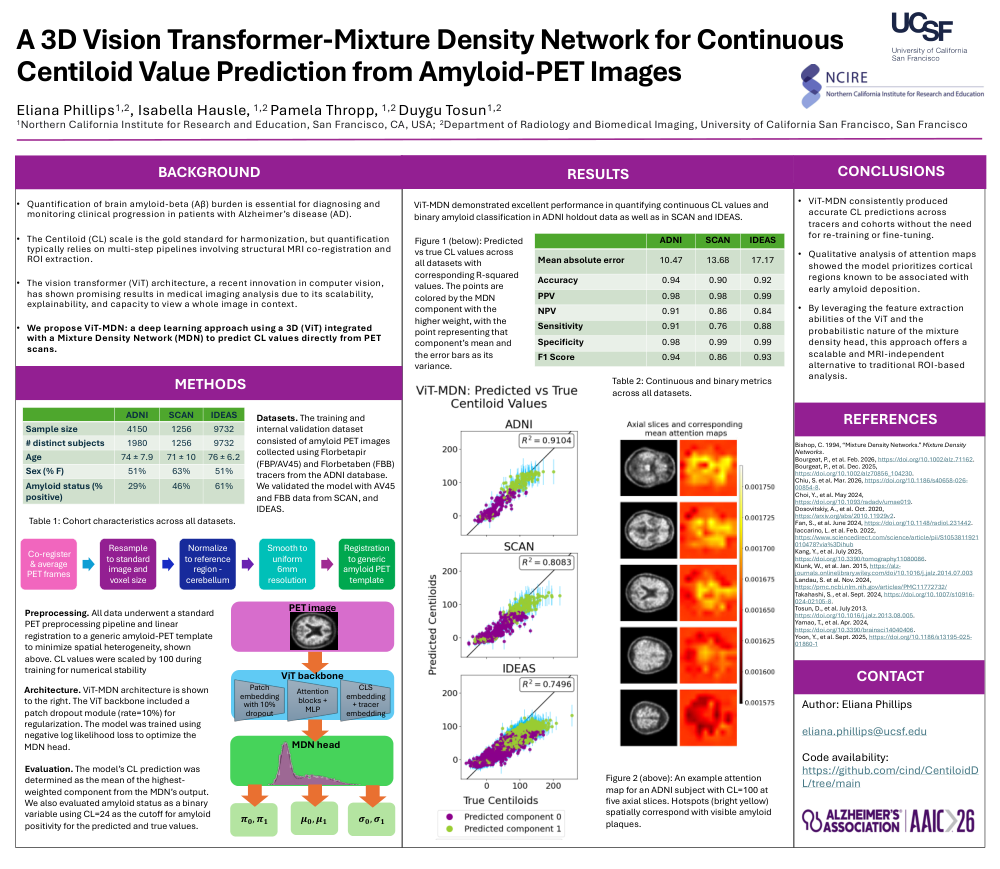
• We propose ViT-MDN: a deep learning approach using a 3D (ViT) integrated with a Mixture Density Network (MDN) to predict CL values directly from PET scans.
Methods
Datasets. The training and internal validation dataset consisted of amyloid PET images collected using Florbetapir (FBP/AV45) and Florbetaben (FBB) tracers from the ADNI database. We validated the model with AV45 and FBB data from SCAN, and IDEAS.
Preprocessing. All data underwent a standard PET preprocessing pipeline and linear registration to a generic amyloid-PET template to minimize spatial heterogeneity, shown above. CL values were scaled by 100 during training for numerical stability
Architecture. ViT-MDN architecture is shown to the right. The ViT backbone included a patch dropout module (rate=10%) for regularization. The model was trained using negative log likelihood loss to optimize the MDN head.
Evaluation. The model’s CL prediction was determined as the mean of the highest-weighted component from the MDN’s output. We also evaluated amyloid status as a binary variable using CL=24 as the cutoff for amyloid positivity for the predicted and true values.
Results
ViT-MDN demonstrated excellent performance in quantifying continuous CL values and binary amyloid classification in ADNI holdout data as well as in SCAN and IDEAS. [figures and tables: regression plots, table of metrics, attention maps]
Conclusions
• ViT-MDN consistently produced accurate CL predictions across tracers and cohorts without the need for re-training or fine-tuning.
• Qualitative analysis of attention maps showed the model prioritizes cortical regions known to be associated with early amyloid deposition.
• By leveraging the feature extraction abilities of the ViT and the probabilistic nature of the mixture density head, this approach offers a scalable and MRI-independent alternative to traditional ROI-based analysis.
Comments
Email is required but is not shown publicly.
Loading comments...